Professor Nitschke and group members were productive over lockdown
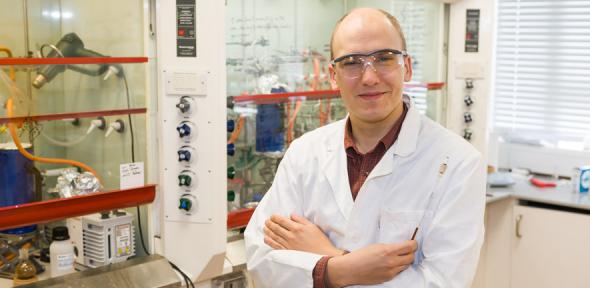
Lockdown was a time for making banana bread, exercising with Joe Wicks or starting a new hobby -- unless you were in the Nitschke lab, where researchers used the time to compile a handbook of metal-organic capsules.
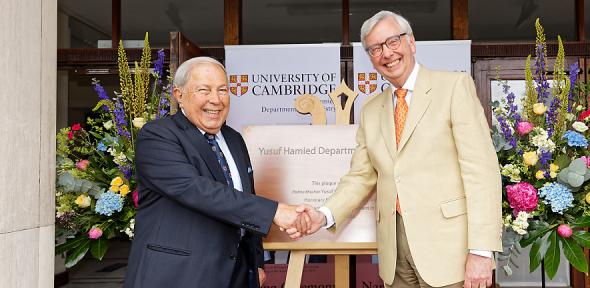
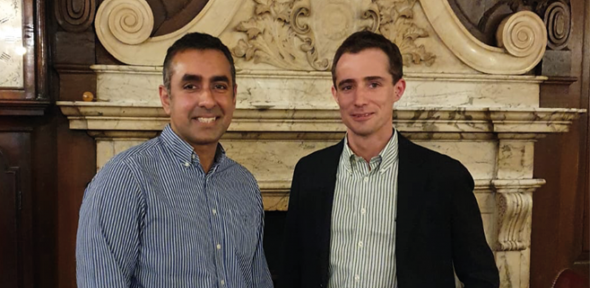
Dr Yusuf Hamied and University of Cambridge Vice-Chacellor Stephen J. Toope at the renaming ceremony
A special ceremony was held on the 7th of July to celebrate the naming of the Department, and to thank Dr Yusuf Hamied and his wife Farida for their generous support.
New “chemical antibody” provides insight into origins of Parkinson’s disease
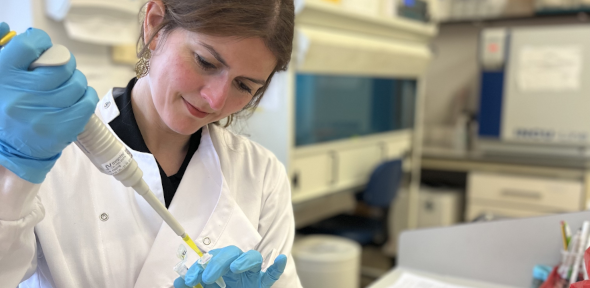
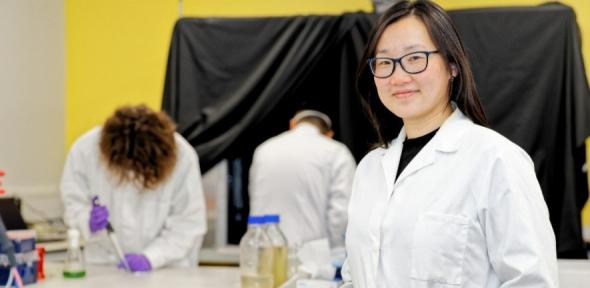
Dr Margarida Dias Rodrigues working in the lab
Researchers have designed a new ‘chemical antibody’ that will help them understand the origins of neurological disorders such as Parkinson’s and Alzheimer’s disease.
New approach topples major barrier to commercialisation of organic flow batteries
Solar panel close up Credit: Andriy Onufriyenko via Getty Images
Researchers from the University of Cambridge and Harvard have developed a method to extend the lifetime of organic aqueous flow batteries, improving their commercial viability to safely and cheaply store energy from renewable sources.
Researchers here have found a way to avoid the toxicity of some plant-derived cancer-killing drugs by 'masking' their toxicity until they reach their targets, potentially leading to more effective cancer therapies.
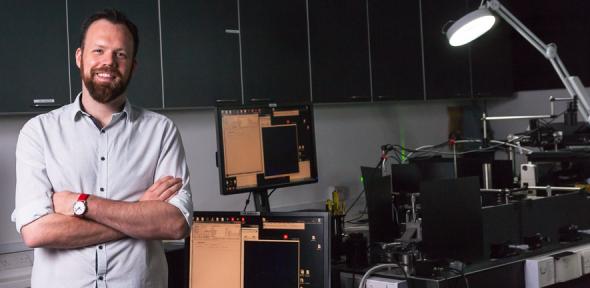
Zomp co-founder Professor Steven Lee, courtesy University of Cambridge.
Professor of Biophysical Chemistry Steven Lee believes that one day ‘to Zomp’ will mean to carry out high-volume, three-dimensional imaging of individual cells.
Innovate UK awards £200k to support development of low-cost rapid diagnostic tests
Dr Saif Ahmad (left), Chief Scientific and Medical Officer at 52 North Health with Dr Pietro Sormanni, Group Leader at the Yusuf Hamied Department of Chemistry at the University of Cambridge, credit to 52 North Health
Innovate UK has awarded £200k for a collaboration between med-tech company 52 North Health and a research group in the Yusuf Hamied Department of Chemistry, University of Cambridge to develop new diagnostic tests for cancer and other diseases.
In the Queen’s Birthday Honours Professor Clare Grey has been appointed as a Dame Commander of the Order of the British Empire (DBE) for services to science.
RSC Horizon Prize recognises development of single-atom alloy catalysts
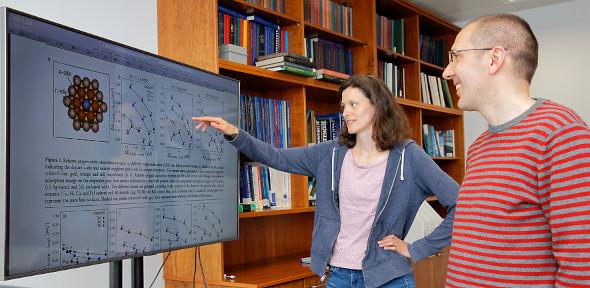
Professor Michaelides and Dr. Schumann discussing computational results that will help increase the understanding of SAA and guide the design of new catalysts. Courtesy Chemistry photography.
A team of researchers from this department in collaboration with three other institutions, has been honoured for developing a new class of catalysts which will provide greener and more energy efficient chemical processes.
Dr Jenny Zhang has been awarded the 2022 L’Oréal-UNESCO For Women in Science UK & Ireland Rising Talent Award in the category of sustainable development.
Professor Clare Grey FRS has been awarded the ACS Central Science Disruptors and Innovators Prize. The award recognises those who advance central science through innovative research.