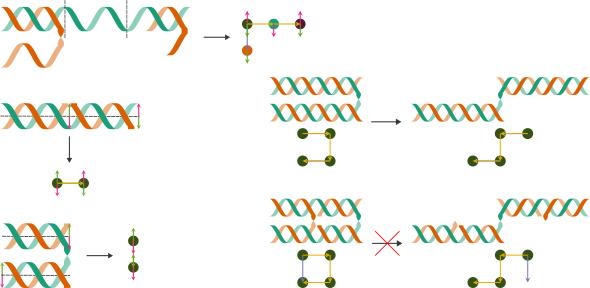
Lattice models provide fast and accurate way to simulate DNA self-assembling
Researchers in this department have proposed a model for accurately simulating DNA self-assembly that balances the need for accuracy within the confines of current computing power.
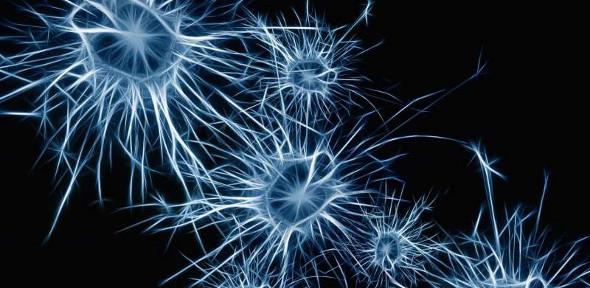
Researchers identify a tau homeostasis signature that underlies Alzheimer’s disease
Image of a neuron CC0 public domain
Researchers have long known that Alzheimer’s is characterized by abnormal clusters of rogue misfolded proteins. A healthy brain has a “quality control system” that effectively keeps them at bay. But problems start when this system goes wrong.
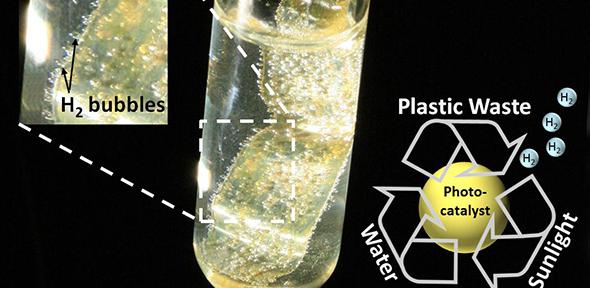
A researcher from this department will lead one of the new projects announced today by the Science Minister to rethink plastics production and use, and tackle plastic waste.
Understanding how volcanic plumes impact the atmosphere
Image: Clare Donaldson
A scientist here studying how volcanic eruptions affect air quality and climate is involved in a major new initiative to tackle key environmental issues.
Congratulations to four colleagues named Highly Cited Researchers 2018 for the number of their research papers ranked in the top 1% by citations in Web of Science.
New product from Chemistry spin-out tops 2018 innovations list
Image: Sphere Fluidics
A new device made by Sphere Fluidics – a spin-out company co-founded by researchers from this department – is ranked number one in The Scientist's 2018 list of Top 10 Innovations.
Dual strategy reveals secrets of collagen structure
Courtesy Dr Barth van Rossum
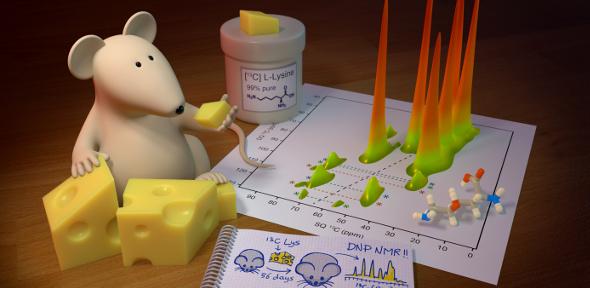
Researchers in the Duer group have used an enhanced NMR technique combined with improved isotope labelling to identify for the first time chemicals vital for assembling and maintaining the structure of connective tissues such as bone and cartilage.
The 1702 Chair of Chemistry at Cambridge – one of the longest-established Chemistry Chairs in the UK – is to be renamed in honour of a distinguished alumnus whose generous new donation will support it in future.
‘Against the odds’ discovery creates new tool for adding functions to proteins
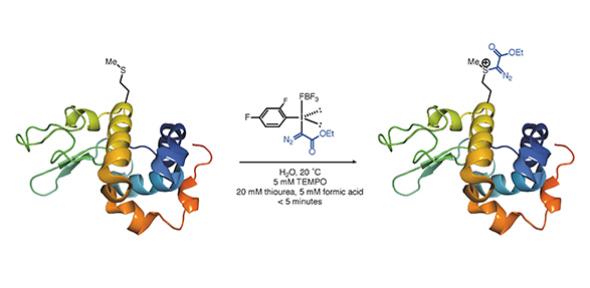
Using a chemical reaction that "really shouldn’t work” on an under-explored and not very reactive amino acid, researchers have developed a new system for adding functions to proteins that could be used to deliver drugs to targeted cells.
Researchers' new method for synthesising molecules desirable in drug discovery
Image: Department of Chemistry
Researchers here have invented an effective and operationally straightforward process for producing a type of compounds – complex alkylamines – whose physical properties make them desirable in drug discovery programmes.