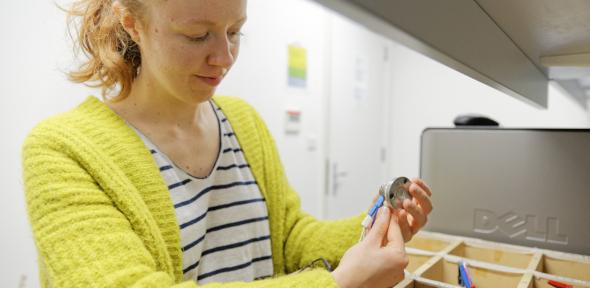
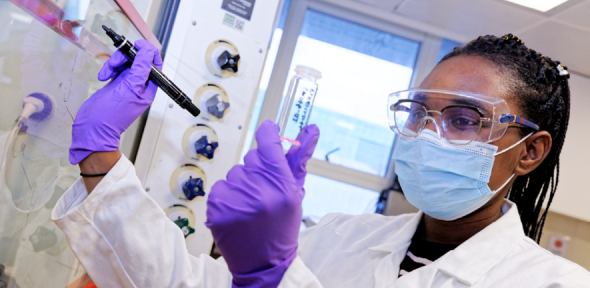
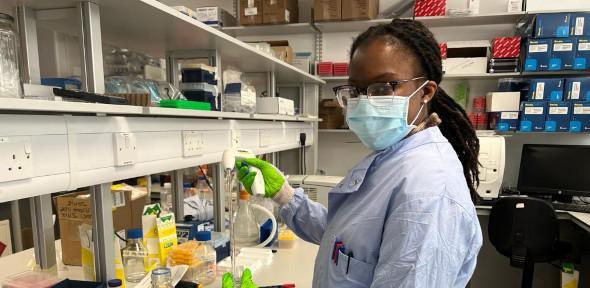
PhD student Alice Merryweather is a member of the Faraday battery project team
A new, low-cost technique for measuring energy storage inside operating batteries should speed up the development of next-generation battery materials.
Learning to use AI to help solve Alzheimer's disease
PhD student Ryan Geiser was inspired to research Alzheimer's disease
Just weeks before losing his grandfather to Alzheimer’s, Ryan Geiser took a genetic test that showed he had a slightly increased risk of developing the same debilitating disease.
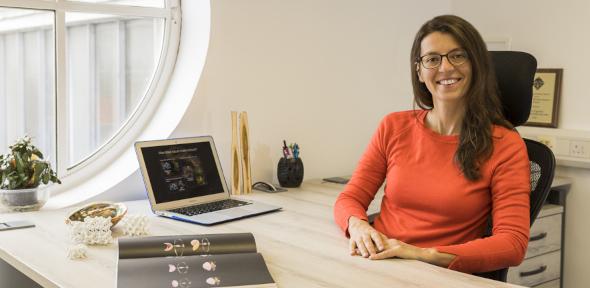
Professor Silvia Vignolini, courtesy @ChemistryPhotography
Professor of Chemistry and Bio-materials Silvia Vignolini has been awarded a Royal Academy of Engineering Chair in Emerging Technologies worth £2.5 million.
Artificial leaf array recognised in solar fuel competition
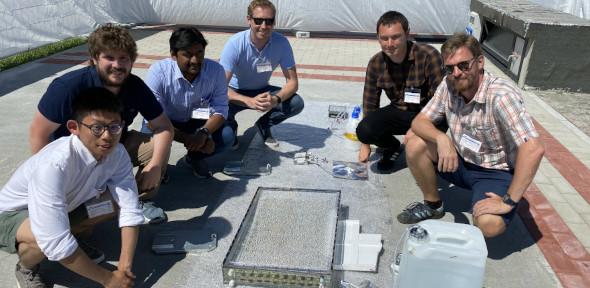
The Cambridge team and their artificial leaf array
A team of University of Cambridge researchers have reached the final of the EU "Fuel from the Sun" competition with their artificial leaf array which converts sunlight to solar fuel.
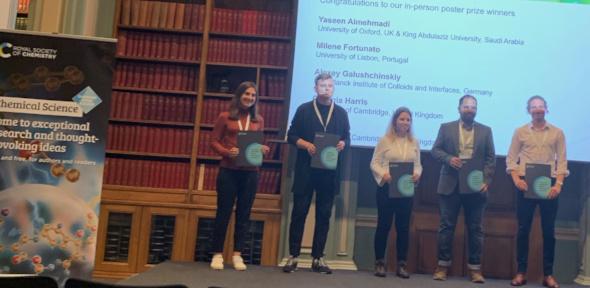
The prize winners take the stage at the Symposium, courtesy Philip Murray
Two postgraduates in the Gaunt group were recognised for their outstanding research posters at the Royal Society of Chemistry Chemical Science Symposium in November.
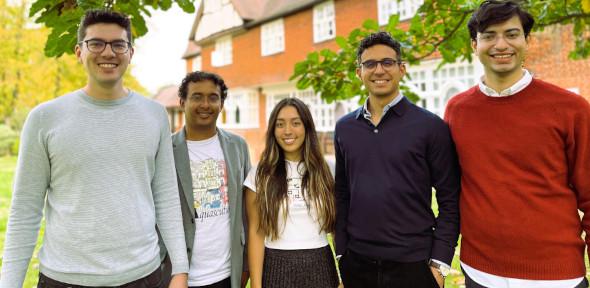
From left: Matt Greenig, Srijit Seal, Elsa Lawrence, Adham El-Shazly and Chaitanya K Joshi
Two students from our Department, with colleagues in Computer Science, Philosophy and Pharmacology, have been awarded a grant to investigate the application of artificial intelligence in biological discovery.
1968 Professor of Chemistry Angelos Michalides, courtesy Chemistry Photography
An international team jointly led by 1968 Professor of Chemistry Angelos Michaelides has received a €10 million grant to better understand water that’s confined to nanometre dimensions.
Power Cuts spark passion for clean energy revolution
Sandile Mtetwa, courtesy @University of Cambridge
Final year PhD student, Sandile Mtetwa, experienced a lot of power cuts during her undergraduate years at the University of Zimbabwe, which got her thinking about energy and sustainability.
PhD student promotes Black Women in Science network
PhD student Tomi Akingbade runs The Black Women in Science Network.
As an undergraduate at the University of Nottingham in 2018, Oluwatomi Akingbade was keen to meet other Black women in science. Now ‘The Black Women in Science Network’ she founded has over 100 members and is still growing.