Read more

Professor Nicholas Kotov gives Melville Lectures

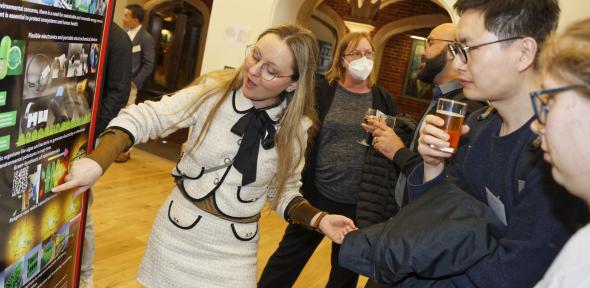
Professor Kotov meets students after the lecture, courtesy @ChemistryPhotography

This year’s prestigious Melville Lectures were given by Professor Nicholas Kotov, an international leader in inorganic nanoparticle research.


Read more

Students choose outstanding supervisor

Professor Angelos Michaelides, courtesy @ChemistryPhotography

Professor Angelos Michaelides has been chosen by postgrads in the department as Outstanding Supervisor of the year.


Read more

Driving on sunshine: clean, usable liquid fuels made from solar power

The artificial leaf can produce liquid multi-carbon fuels using sunlight

Researchers from the Reisner group have developed a solar-powered technology that converts carbon dioxide and water into liquid fuels that can be added directly to a car’s engine as drop-in fuel. 


Read more

Postgrad awarded Vice-Chancellor’s Social Impact Award in Sustainability

Chloe receiving her award, courtesy Cambridge Hub

PhD student Chloe Balhatchet has been awarded the Vice-Chancellor’s Social Impact Award in Sustainability.


Read more

Excellence in Chemical Biology award

Gonçalo Bernardes, taken by Nathan Pitt ©University of Cambridge

Professor Gonçalo Bernardes has been honoured for his ground-breaking contributions to chemical and cancer biology.


Read more

International recognition for departmental researchers

Professor Sir Shankar Balasubramanian, courtesy @Chemistry

Professor Sir Shankar Balasubramanian and Professor Jane Clarke have been elected as International Members of the National Academy of Sciences of the USA.


Read more

New approach targets and degrades RNA to tackle COVID-19

First author Sigitas Mikutis, courtesy Hazemi and Bindu

Researchers here have developed a system that directly targets and degrades viral RNA, which can be adapted to fight many viruses including that which causes COVID-19.


Read more

'Intelligent' membranes have memories

Artist's view of intelligent membranes with memory effects, courtesy R.Nair

Researchers have made 'intelligent' membranes whose 'memory' can be used in areas like drug delivery, water purification, sensors and memory devices.


Read more

Black Women in Science Network brunch

The Black Women in Science Network brunch. Nathan Pitt, University of Cambridge.

PhD student Tomi Akingbade alongside Juliana Eniraiyetan organised a networking brunch for black women in science from all across the UK and it was a huge success.


Read more

Super-sized nanocage could deliver bigger drug cargoes

Professor Jonathan Nitschke, courtesy Chemistry Photography

Think about how frustrating it is to try to fit a gift into a box that is too small. Sometimes you just need a bigger box.


Read more

T cells use their ‘fingers’ to poke holes in toxic cells

Professor Sir David Klenerman, courtesy Chemistry Photography

Researchers here have discovered how T cells detect danger by using their ‘fingers’ to poke holes in suspect cells.


Read more

Lab Technicians needed

Technicians often help with Dr Peter Wothers' Open Day lectures, courtesy Chemistry Photography

We are looking for a Chemistry Research Lab Technician or Trainee Sernior Research Lab Technician - apply by 16 April!


Read more

New investment for battery degradation research

Professor Dame Clare Grey has a leading role in the research, courtesy Chemistry Photography

Professor Dame Clare Grey of this department will take a leading role in a new £29 million funding commitment to UK battery research.


Read more

The joy of discovery

Ben Feringa, Sally Boss, John Hopkins and Jeremy Sanders with photo of Alex, courtesy Chemistry photography

This year’s Alex Hopkins memorial lecture was given by Nobel Laureate Professor Ben Feringa.


Read more

Photosynthesis 'hack' could lead to new ways of generating renewable energy

Illustration of cells and electrons during photosynthesis, illustrated by Robin Horton

An in-depth study of photosynthesis could lead to new ways of generating clean fuel and renewable energy.