As easy as counting to ten – a new rule for catalysts’ design
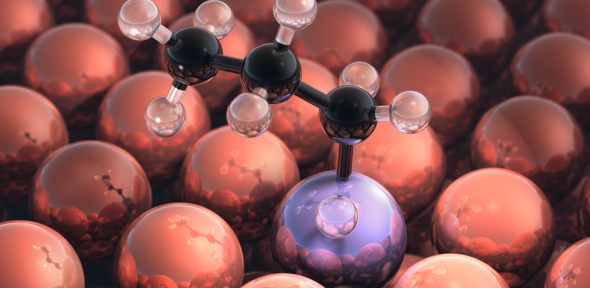
Dehydrogenation of propane (black) on a single-atom alloy (purple) which is diluted in an inert metal (red) made by Michail Stamatakis from Julia Schumann's figures courtesy University of Cambridge.
The ‘ten electron’ rule provides guidance for the design of single-atom alloy catalysts for targeted chemical reactions.
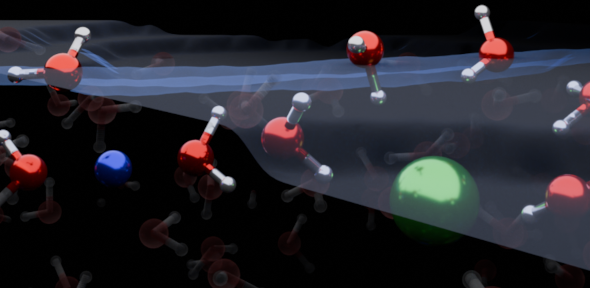
Graphic representation of the liquid/air interface in a sodium chloride solution, courtesy Yair Litman
Textbook models will need to be re-drawn after a team of researchers found that water molecules at the surface of salt water are organised differently than previously thought.
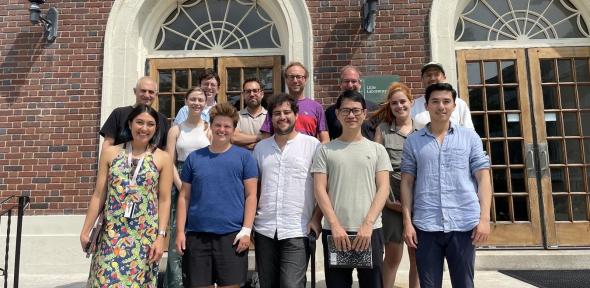
Chromatin Consortium courtesy of the Marine Biological Laboratory at the University of Chicago.
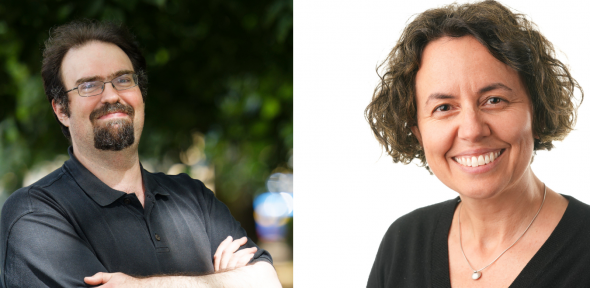
Members of the Collepardo lab took part in a month-long ’Chromatin Consortium’ to help unfold the mysteries of the material that makes up our chromosomes.
Herchel Smith Fellowship extended application deadline
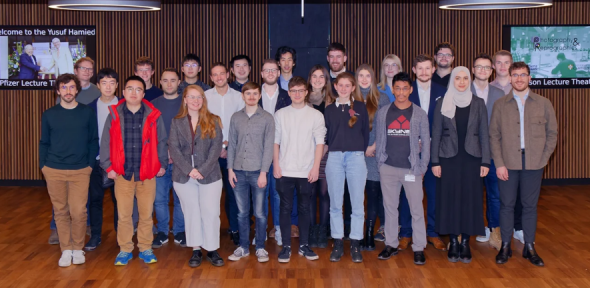
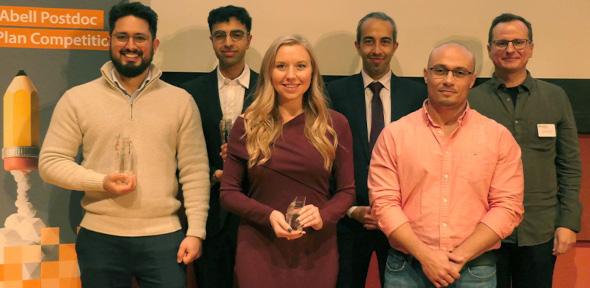
Herchel Smith Fellow in the Gaunt Group Dr Alexander Fawcett (middle row, far right) is now a Senior Scientist at a local pharma company.
We have extended the application deadline for a three-year Herchel Smith Postdoctoral Research Fellowship in Organic or Biological Chemistry to 31 December 2023.
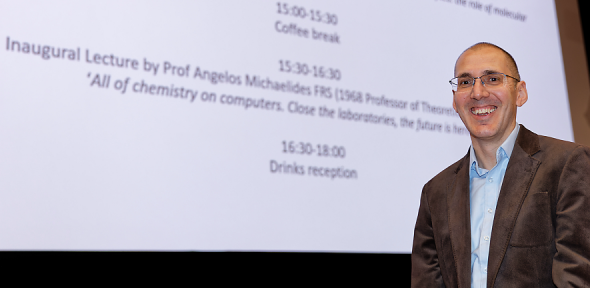
Professor Angelos Michaelides, courtesy Chemistry Photography
1968 Professor of Theoretical Chemistry Angelos Michaelides FRS has given the first talk in a lecture series which will give academics the opportunity to share their research with other department members.
Custom-built molecules may lead to metal-free, air tolerant batteries
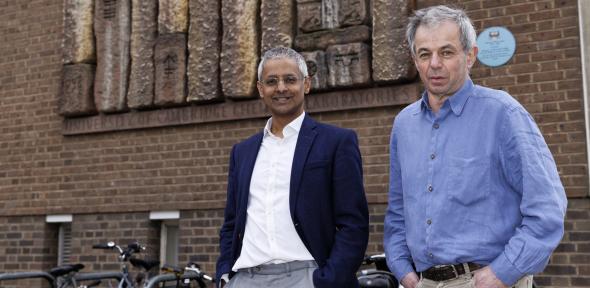
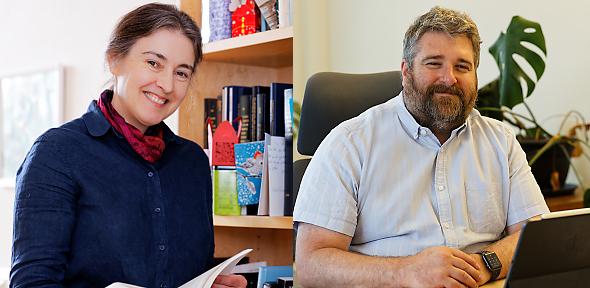
Professor Dame Clare Grey and Professor Oren Scherman, courtesy Chemistry Photography
In research published in Nature, scientists from the Scherman and Grey research groups demonstrate a path to batteries that do not contain rare metals and are stable in the air.
Study shows that performance analysis of the same data set produce varying results. Researchers invite labs to join follow-up trial to improve supercapacitor analysis.