New study reveals that quantum information can spread rapidly without chaos
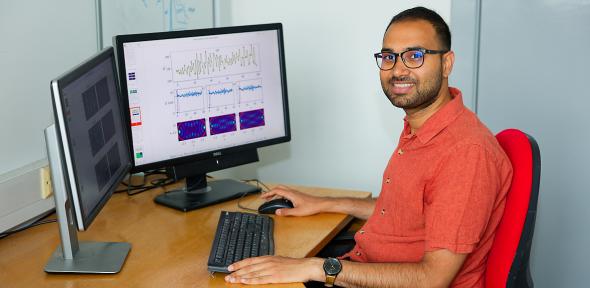
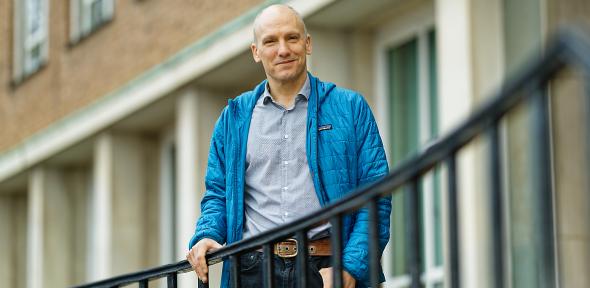
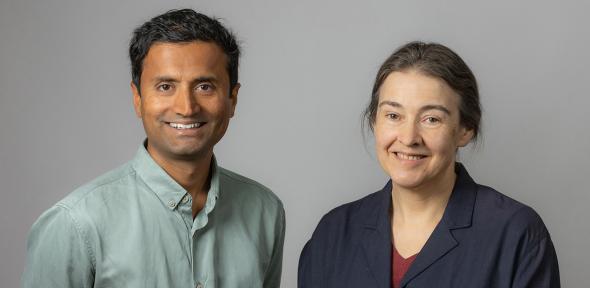
Vijay Ganesh Sadhasivam. Image by Michael Webb@Cambridge
A new study led by Dr Vijay Ganesh Sadhasivam, recently published in Physical Review Letters, has revealed that quantum information can spread extremely quickly even in simple systems that are not chaotic, challenging a long-standing idea about how information moves through the quantum world.
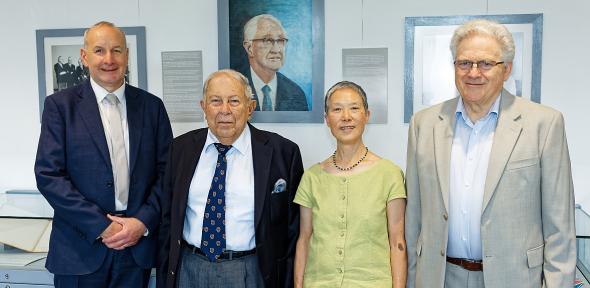
A major gift from our benefactor, Dr Yusuf Hamied FRS Hon FRSC Hon ScD, has enabled us to transform two research laboratories at the Department of Chemistry, creating exceptional spaces for scientific discovery while honouring two outstanding colleagues.
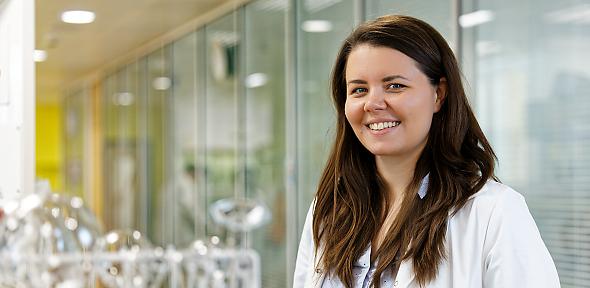
Dr Sona Krajcovicova and colleagues have developed an improved and more scalable method for producing specialised chemical linkers that enable antibodies to be engineered as precise delivery vehicles. The method, recently published in Nature Protocols, could support the development of more consistent and controlled medicines.
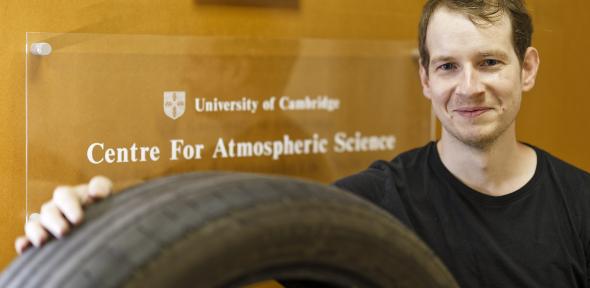
Research by Siriel Saladin, a researcher within the Aerosol Science CDT, has been featured in a CDT case study, highlighting his work challenging a widely accepted assumption in air pollution science.
Cambridge scientists uncover how water behaves at the nanoscale
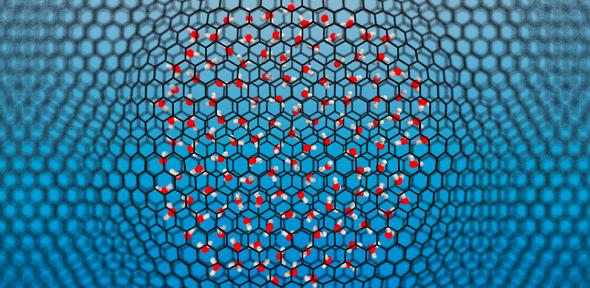
A handful of water molecules: a top-down view of a nanoscale water droplet trapped between two-dimensional sheets of graphene. Image: courtesy of Xavier Rosas Advincula
Scientists at Cambridge have helped resolve a long-standing question about how water behaves when confined to spaces just a few molecules wide, in work that could inform the design of batteries, fuel cells and nanofluidic devices.
n-AQUA team honoured with Royal Society of Chemistry Faraday Horizon Prize
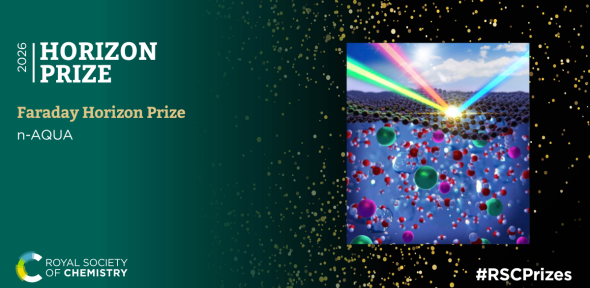
Image credit: Royal Society of Chemistry Horizon prize
n-AQUA (nanoscale water), a major collaborative effort involving many of our researchers, has been awarded the Royal Society of Chemistry’s Faraday Horizon Prize. The prize recognises the team’s groundbreaking discoveries showing how water’s structure and behaviour change when it is confined to the nanoscale or interacts with low dimensional interfaces.
Three Royal Society of Chemistry Awards for departmental researchers
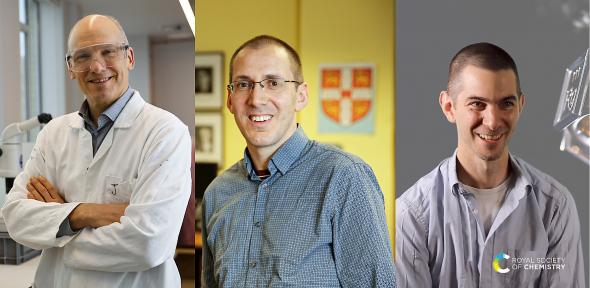
From left: Jonathan Nitschke, Angelos Michaelides and Hugo Bronstein.
The Department warmly congratulates Professor Jonathan Nitschke, Professor Angelos Michaelides and Professor Hugo Bronstein on receiving their respective RSC prizes.
Researchers from the Zhang Group at the University of Cambridge have uncovered why a class of molecules crucial to emerging green energy technologies rapidly lose performance in water – and developed a simple chemical strategy that could dramatically improve the performance of experimental “living solar panels.”
Cambridge Chemistry Alumni Elected Fellows of the Royal Society 2026
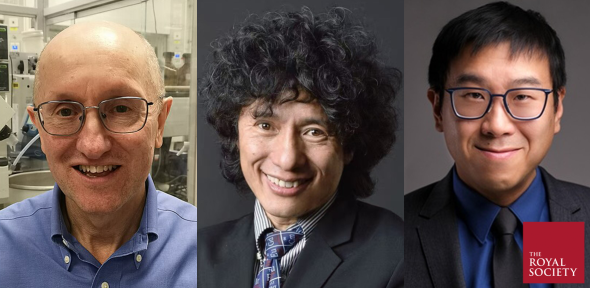
From left: David Rees, Jin-Quan Yu and Garnet Kin-Lic Chan
Three distinguished alumni of the Yusuf Hamied Department of Chemistry at the University of Cambridge have been elected Fellows of the Royal Society, one of the highest honours in science.
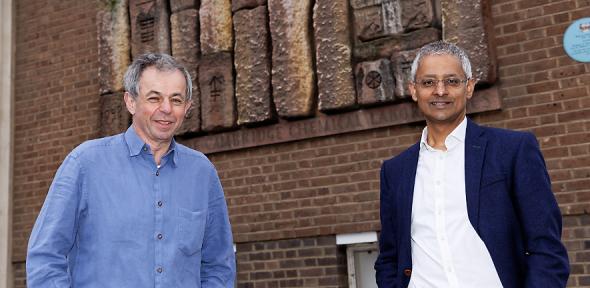
Professor Sir David Klenerman and Professor Sir Shankar Balasubramanian have been recognised with the William Bate Hardy Prize 2026 for their outstanding contributions to chemical science and innovation.
Cambridge scientists win 2026 Princess of Asturias Award for DNA sequencing breakthrough
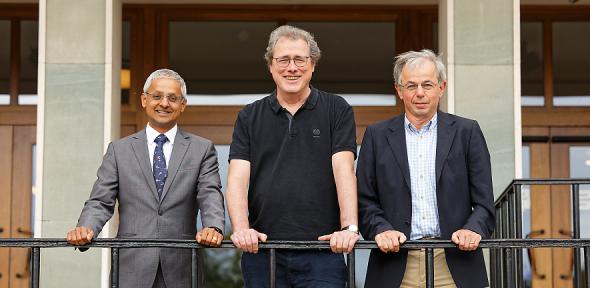
From left Prof. Shankar Balasubramanian, Prof. Pascal Mayer, and Prof. David Klenerman. Image credit: Michael Webb, Photography and Reprographics, Yusuf Hamied Department of Chemistry.
Prof. Sir Shankar Balasubramanian, Prof. Sir David Klenerman, and French biophysicist Prof. Pascal Mayer have been awarded the 2026 Princess of Asturias Award for Scientific and Technical Research for their work that transformed DNA sequencing.
Cambridge spinout Nyobolt shows research-to-impact success with $1bn valuation milestone
Dr Sai Shivareddy (Left), Professor Dame Clare Grey (Right).
Cambridge spinout Nyobolt has raised $60 million in Series C funding at a valuation of over $1 billion, marking a major milestone in the translation of battery research from the University of Cambridge into real-world applications.
In Memoriam: Professor Ruth Lynden-Bell (1937–2026)
Gabriella Brocchetti @University of Cambridge
It is with deep sadness that the Department announces the death of Professor Ruth Lynden-Bell, Professor Emerita of Queen’s University Belfast, an alumna of the Department and a long-standing visiting professor.
Chemistry PhD Andrea Rogolino Wins Gold at UK Parliament
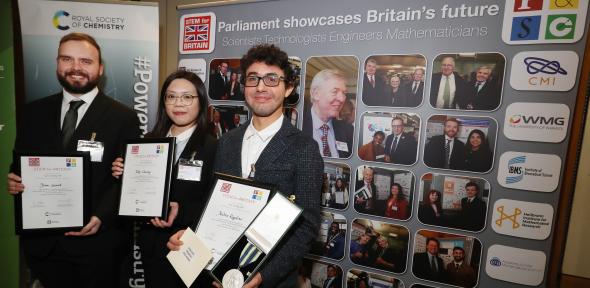
Andrea Rogolino on the right. Image, courtesy of STEM For Britain
Andrea Rogolino, a final-year PhD student in the Reisner group, attended Parliament to present his chemistry research to a range of politicians and a panel of expert judges as part of the Parliamentary & Scientific Committee’s STEM for BRITAIN on 17 March.