

Professor of Chemistry & Chemical Biology


Our research interests originate from a desire to understand and exploit biological systems using organic synthesis primarily. Listed below are areas of research that we are exploring; for more detailed information visit the Spring Group web pages.

We collaborate with many chemical companies and academic groups around the world. The scientific education of group members in organic synthesis is given a high priority; however, they are encouraged also to learn and perform new techniques relating to their projects with our industrial and academic collaborators. Every effort is made so that group members achieve their career ambitions, usually jobs in academia or the chemical industries.
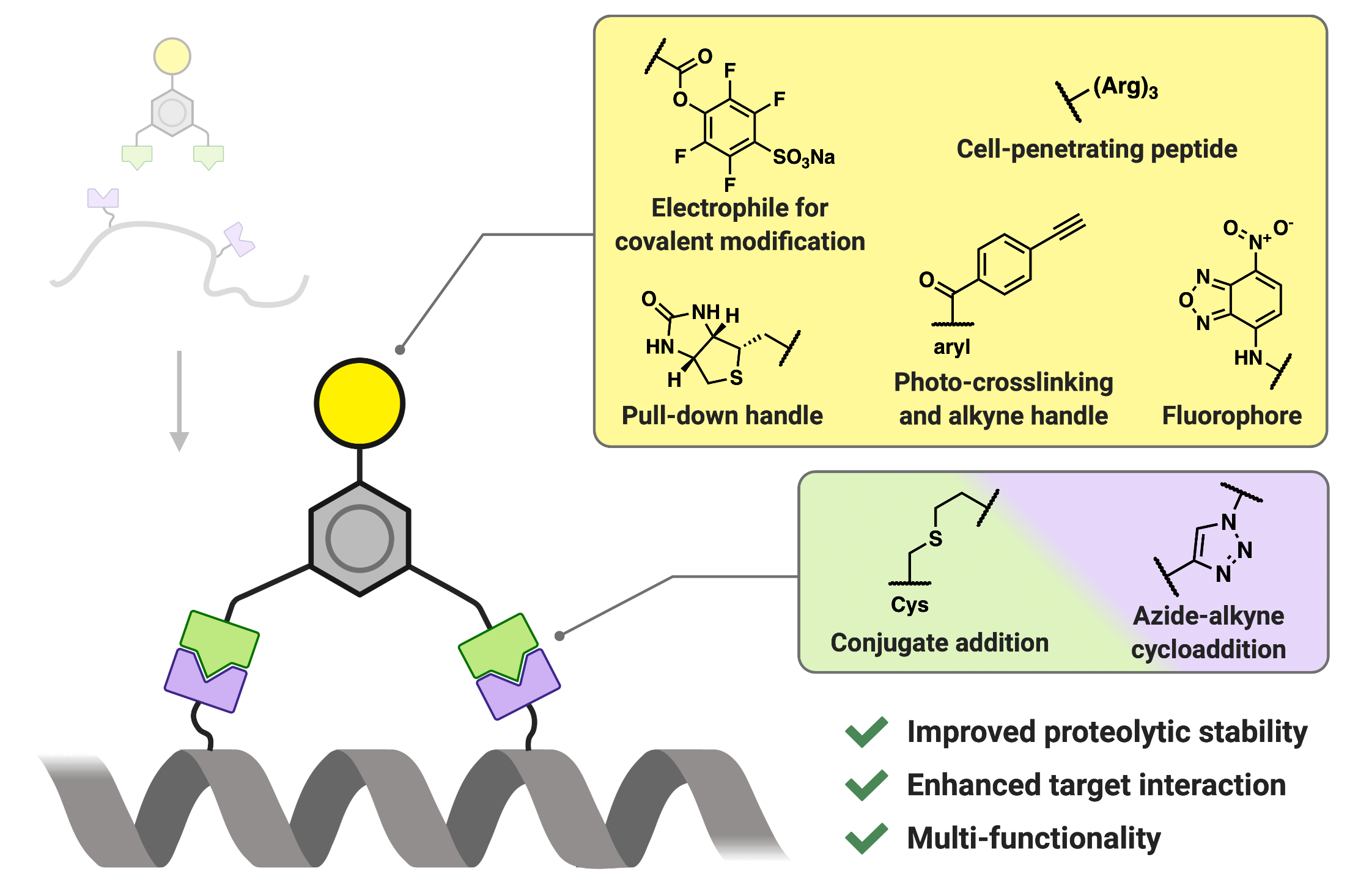
Spring Group Figure


Watch Professor David Spring discuss his research

Take a quick tour of the Spring Lab

For more detailed information please visit the Spring Group research pages.

Teaching

If you are looking for the teaching material from my lecture courses, then please go to the Moodle website.

Publications

For a list of all our publications please visit the Spring Group publication page.

Publications

Assessment of structural diversity in combinatorial synthesis
S Fergus, A Bender, DR Spring
Current opinion in chemical biology
(2005)
9
Chemical genetics to chemical genomics: Small molecules offer big insights
DR Spring
Chemical Society reviews
(2005)
34
Aryl – aryl coupling via directed lithiation and oxidation
DS Surry, DJ Fox, SJF Macdonald, DR Spring
Chemical communications (Cambridge, England)
(2005)
Finding new components of the target of rapamycin (TOR) signaling network through chemical genetics and proteome chips
J Huang, H Zhu, SJ Haggarty, DR Spring, H Hwang, F Jin, M Snyder, SL Schreiber
Proceedings of the National Academy of Sciences of the United States of America
(2004)
101
Synthesis and stability of small molecule probes for Pseudomonas aeruginosa quorum sensing modulation.
FG Glansdorp, GL Thomas, JJK Lee, JM Dutton, GPC Salmond, M Welch, DR Spring
Organic & biomolecular chemistry
(2004)
2
Communications blackout? Do N-acylhomoserine-lactone-degrading enzymes have any role in quorum sensing?
DM Roche, JT Byers, DS Smith, FG Glansdorp, DR Spring, M Welch
Microbiology (Reading)
(2004)
150
Complete functionalisation of small and large diameter bromopolystyrene beads; applications for solid-supported reagents, scavengers and diversity-oriented synthesis.
GL Thomas, M Ladlow, DR Spring
Organic & biomolecular chemistry
(2004)
2
Organocuprate oxidation with improved functional group tolerance and its application to medium ring synthesis
DS Surry, DR Spring
ABSTRACTS OF PAPERS OF THE AMERICAN CHEMICAL SOCIETY
(2004)
227
Highlights from the 39th ESF/EUCHEM Conference on Stereochemistry, Bürgenstock, Switzerland, April 2004
CJ Hayes, DR Spring
Chemical Communications
(2004)
10
Diversity-oriented synthesis; a challenge for synthetic chemists
DR Spring
Organic & Biomolecular Chemistry
(2003)
1

Research Group

Research Interest Groups

Telephone number

01223 336498

Email address