
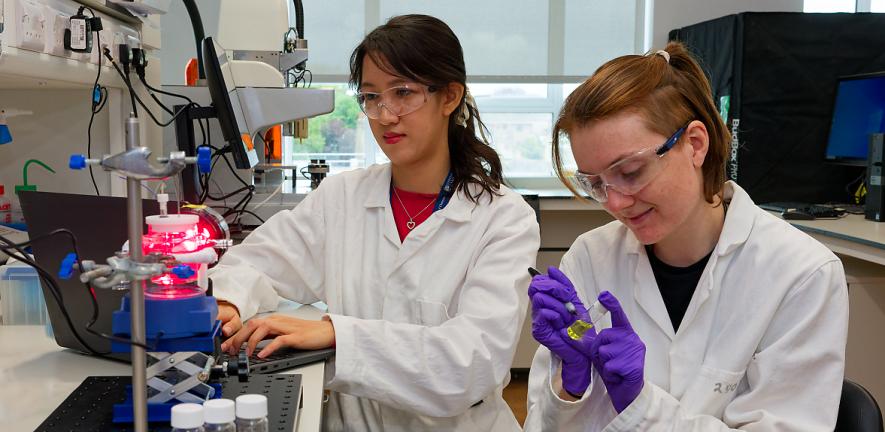
Researchers from the Zhang Group at the University of Cambridge have uncovered why a class of molecules crucial to emerging green energy technologies rapidly lose performance in water – and developed a simple chemical strategy that could dramatically improve the performance of experimental “living solar panels.”
The breakthrough, published in the Journal of the American Chemical Society, could help advance sustainable technologies ranging from biological solar energy systems to next-generation batteries and biosensors.
This is a real breakthrough in photosynthesis research. By understanding why these widely used quinone molecules are unstable and finding ways to stabilise them, we can now study and utilise photosynthetic machinery much more robustly. Dr Jenny Zhang, Yusuf Hamied Department of Chemistry.
The study focused on quinones, a family of molecules used throughout nature to shuttle electrons during processes such as photosynthesis and cellular respiration. Scientists also use synthetic quinones in experimental bio-solar devices where photosynthetic microorganisms generate clean electricity from light energy. However, the technology has faced a major limitation: quinones degrade rapidly in water, causing energy output and system efficiency to decline over time.
First author Shella Jeniferiani Willyam, a PhD student in the Zhang lab, said: "Quinones are incredibly useful molecules because they help move electrons around, both in nature and in technologies inspired by nature. The problem is that they gradually destroy themselves in water. By understanding exactly why that happens, we found a simple way to protect them and keep these systems working for much longer. We hope this will help make sustainable energy technologies more practical, efficient, and durable.”
Previous theories suggested that an initial attack by water molecules themselves was primarily responsible for the damage. But by tracking the chemistry in real time, the researchers discovered that the real culprits are semiquinone radicals – highly reactive, short-lived intermediate molecules that are spontaneously generated through intrinsic instability in water, as well as formed during electron transfer. These unstable radicals trigger destructive chain reactions that rapidly break down the quinones and disrupt electron transport within the system.
To prevent this, the researchers introduced a chemical “helper”, such as ferricyanide, which intercepted the reactive intermediates before they could cause damage and stabilised the entire system. The results were striking. In a living bioelectricity system, the approach extended the lifespan of the electron-shuttling molecules by tenfold while maintaining 73% higher electricity production levels during six hours of operation. The method also allowed researchers to more accurately measure oxygen production during photosynthesis by preventing unwanted side reactions that consume oxygen, boosting the measured rate by nearly 6-fold.
Researchers say the findings provide a new blueprint for designing longer-lasting biological and water-based energy technologies. Future work will focus on developing even more stable molecular systems and improving the efficiency of devices that convert sunlight into usable energy.
Dr Jenny Zhang commented: "This is a real breakthrough especially in the field of photosynthesis where these quinone molecules are widely used to help study or enhance biological activity. Here, we show that the unstable nature of these molecules may have contributed to significant misinterpretations in the past. By rationally unpicking why and finding reliable ways to stabilise these molecules, we can now study and utilise photosynthetic machineries in much more robust ways."
The text in this work is licensed under a Creative Commons Attribution-NonCommercial-ShareAlike 4.0 International License.
Images, including videos, are Copyright © University of Cambridge and licensors/contributors as identified. All rights reserved. We make our image and video content available in a number of ways that permit your use and sharing of our content under their respective terms.
