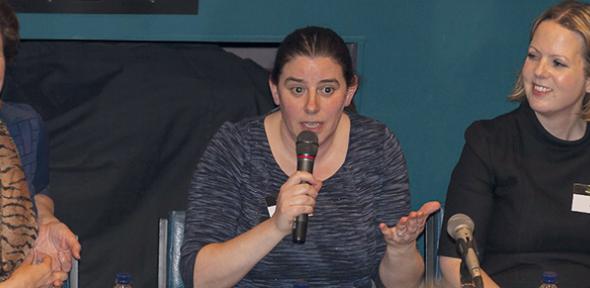
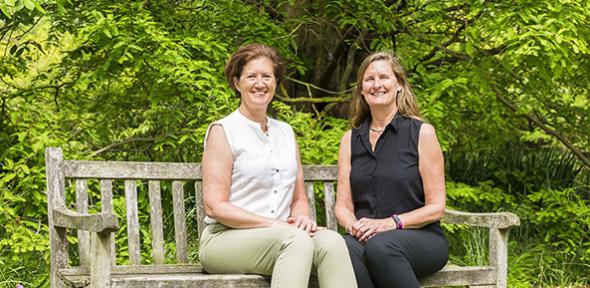
Many questions – on women-only prizes, the role of job sharing in academic research and how to overcome imposter syndrome – arose at our 2019 Women in Chemistry alumni event, as you can see on our new video.
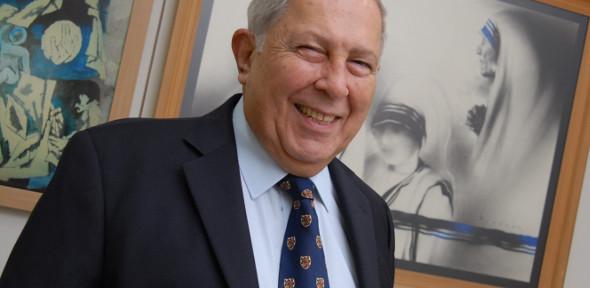
Two alumni of this department have just had their portraits painted as part of Viewing the Invisible - a BBSRC-funded project bringing scientists together with artists to explore the similarities in their working methods.
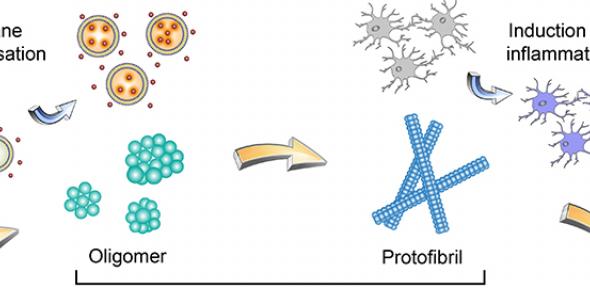
Researchers detect proteins responsible for Alzheimer's in spinal fluid
For the first time, researchers here have detected and measured the soluble protein aggregates associated with the progression of Alzheimer’s disease in the spinal fluid of patients with both early-stage and advanced forms of the disease.
A departmental start-up has been chosen as a semi-finalist in the Cambridge Enterprise Postdoc Business Competition. Pept2Smart is aiming to provide researchers with the tools to create new types of drugs to treat diseases that other drugs cannot.
Josie Gaynord is a PhD candidate in the Department of Chemistry under the supervision of Professor David Spring. Her research looks at one of the biggest problems threatening global public health: antimicrobial resistance, or AMR.
Professor Matthew Gaunt, an outstanding synthetic chemist whose work has been recognised by a series of prestigious awards, has been elected the 16th holder of the Yusuf Hamied 1702 Chair of Chemistry at the University of Cambridge.
We'll be welcoming prospective undergraduates during the University Open Days on Thursday and Friday. They are coming to find out what it's like to study here, and we'll be offering them a sample lecture.
Cause of hardening of the arteries - and potential treatment - identified
Image: Department of Chemistry Photography
Research co-led by this department has identified the mechanism behind the hardening of the arteries - and shown in animal studies that an antibiotic widely prescribed for acne could be an effective treatment.
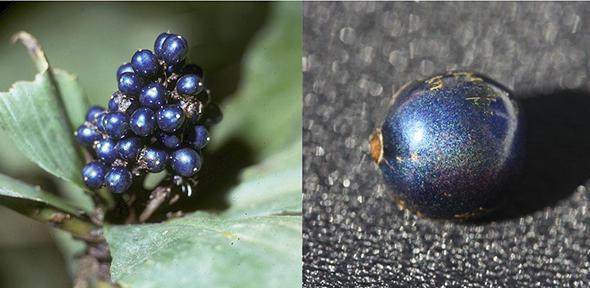
Image: the bright colour of pollia condensata berries stems from helicoidal cellulose structures in the cell walls
Researchers here studying the way Nature manages and manipulates light argue in the journal Nature Photonics that cellulose is an ideal candidate for the development of more renewable and biodegradable photonic materials.
Congratulating our colleague on a synthetic biology breakthrough
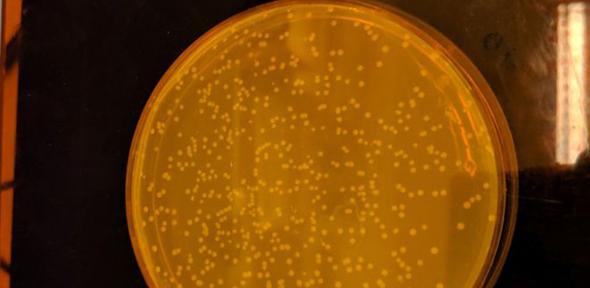
Image showing Syn61 replicating and dividing: courtesy of Jason Chin
Congratulations to our colleague Professor Jason Chin and his team who, in creating an artificial version of E. coli with synthetic DNA, have paved the way for designer bacteria that could manufacture new materials, drugs and proteins.
Researchers across the department recognised in RSC Awards
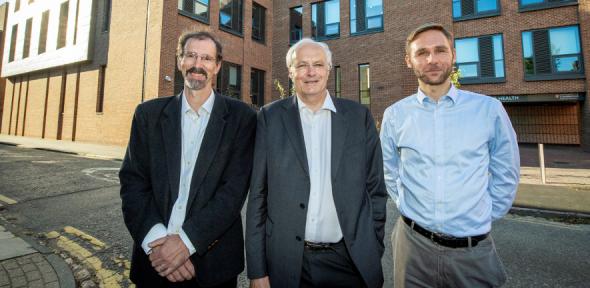
Image: courtesy of Cambridge Independent
Six researchers from this department have received prestigious Royal Society of Chemistry prizes. Their work spans the molecular origins of neurodegenerative diseases, synthetic organic chemistry and electrochemical devices.
A study by researchers here that was published in the wake of two high-profile Alzheimer’s drug trial failures offers evidence for taking a wider approach to treating the disease.
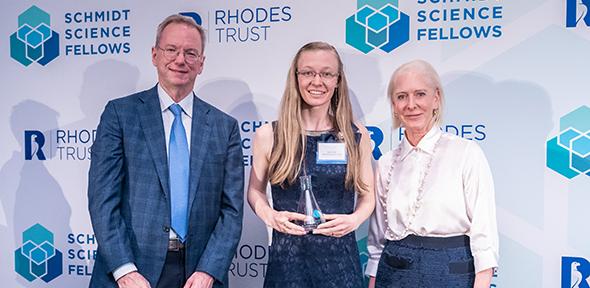
A young researcher studying protein-misfolding in neurodegenerative diseases has been elected to the 2019 Schmidt Science Fellows programme. This aims to develop future science leaders who can address the world's most significant problems.