
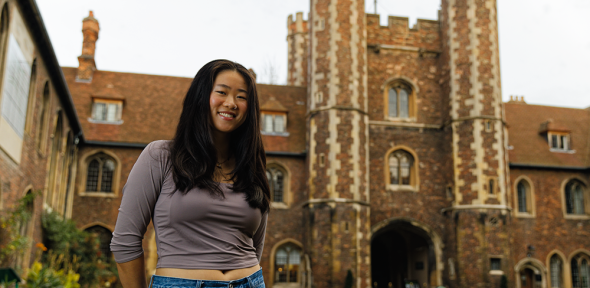
Sabrina Hu is a third-year PhD student in The Nitschke Group who is researching metal-organic cages. Her PhD is funded by a Gates Scholarship and she is part of Queens’ College.
Metalorganic cages
Sabrina researches molecular structures called metal-organic cages. These are like wireframes: a strong scaffold with a void in the centre that can store other molecules. They are useful for collecting carbon dioxide from the air or storing gases such as hydrogen and have potential uses in waste clean-up or even drug delivery.
She is synthesising a particular structure called a Borromean ring which is actually three linked hoops. They are curious because if you remove one ring the other two are also no longer linked, imagining it is rather like solving a metal rings brain-teaser puzzle.
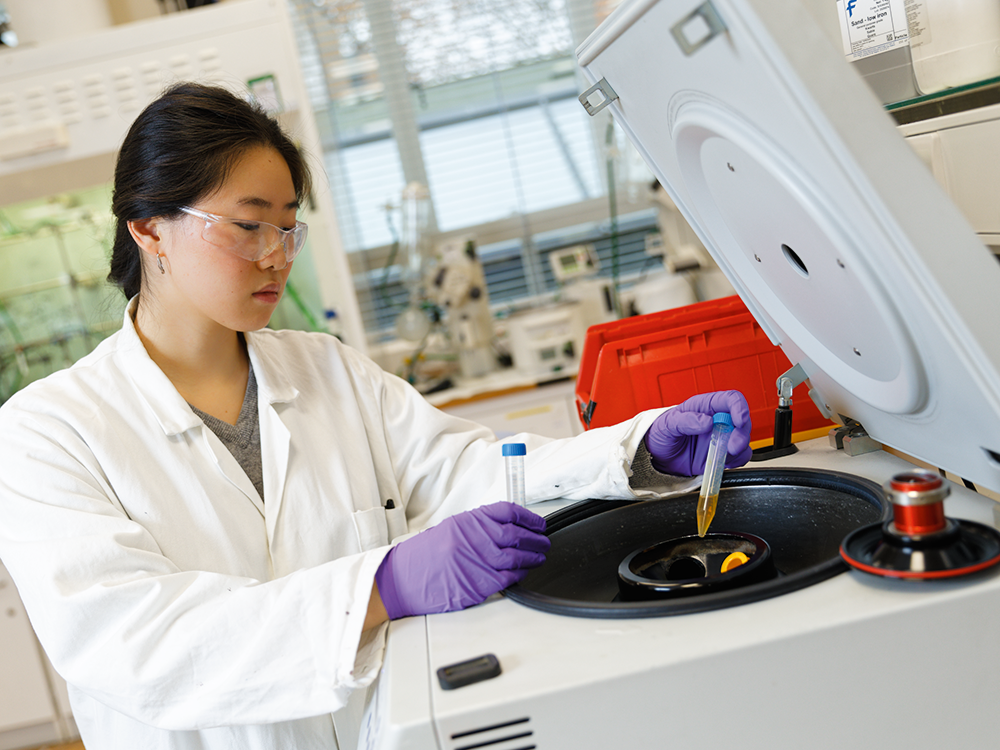
She uses Nuclear Magnetic Resonance spectroscopy to test the molecular structures of her reactions and understand the symmetry of the cages that she makes. Sabrina is interested in refining the exact point where the rings link to add robustness to the Borromean ring.
“We’re coming up with ways to link Borromean rings more precisely to open up possibilities to synthesise more complicated architecture. It’s not easy because everything is so small. Once we crack this, there are potential applications for storing gases and selectively cleaning up gases from a mixture, so a sustainable angle.”
Backstory
Originally from Houston, Texas, Sabrina did her undergraduate degree in Washington University in St Louis.
“Interestingly, I started as a psychology major. Fortunately, the American university system keeps study more general and you specialise later. It was in my second year that I switched to chemistry after some very enjoyable organic chemistry modules.”
Whilst studying at Washington University, Sabrina worked on summer internships developing and refining a catalyst to polymerise polylactic acid; a bio-renewable material that is plentiful in the agricultural industry. Polylactic acid is used in recyclable cups and 3D printing and there is emphasis in the field on renewable resources and sustainability.
Environmental work
Sustainability has interested Sabrina her whole life and at Washington University she had the opportunity to put this passion into practice.
“I’ve joined a few different sustainability initiatives over the years and I am interested in how we quantify how sustainable something is. I interned at Washington University and prepared documentation in preparation for transitioning to geothermal energy. I researched approaches and potential problems and the University ended up hiring an engineering firm that I had scouted. It was an incredible opportunity to get some real-world experience.”
The Nitschke Group
After studying in the USA and an internship in Bochum, Germany working on cathodes, Sabrina met Professor Jonathan Nitschke at a conference. This coincidence led Sabrina to apply for a PhD in his laboratory where she is soon to publish her first paper as a second author in a publication that has now been accepted in Angewandte.
The lead author, Dr Yuchong Yang, is a postdoc in the Nitschke group, and they researched knotted zinc framework and a new species they’ve made.
“I’m also working on a few more papers, including other metal cages that I’ve analysed with NMR spectroscopy. I’ve seen some unusual properties that I need to ponder and I’m ready for the challenge.”
Sabrina will continue her work in metal-organic frameworks and is also a member of the Chemistry Sustainability Group at the department.
This article first appeared in Chem@Cam Issue 72.
