
Professor of Chemical Physics

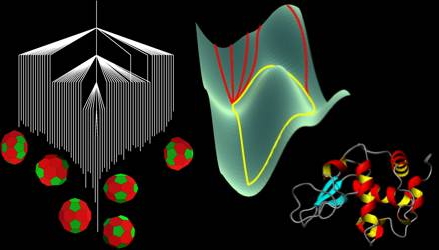
The self-assembly of complex mesoscopic structures, the folding of proteins, and the complicated phenomenology of glasses are all manifestations of the underlying potential energy surface (PES). In each of these fields related ideas have emerged to explain and predict chemical and physical properties in terms of the PES. In studies of clusters and glasses the PES itself is often investigated directly, whereas for proteins and other biomolecules it is also common to define free energy surfaces, as the figure below illustrates for lysozyme.

Applications of energy landscape theory in my group range from studies of tunnelling splitting patterns in small molecules to computer simulation of protein folding and misfolding, including aggregation of misfolded proteins. Other active research topics include global optimisation and investigation of how the thermodynamic and dynamic properties of glasses are related to the underlying PES.

Two recent advances are now providing new insight into larger systems. Discrete path sampling enables dynamical properties to be obtained efficiently, and is being used to calculate folding rates for proteins. Unexpected connections between dynamics and thermodynamics have also been revealed by the application of catastrophe theory to energy landscapes, and new results are now being obtained to characterize phase transitions.

Publications

Balanced Geometries and Structural Trends in Covalent, Ionic, and van der Waals Clusters
DJ Wales
Journal of the American Chemical Society
(2002)
112
Multireference perturbation study of ClF 4 +
T Taketsugu, DJ Wales
Physical Chemistry Chemical Physics
(2002)
4
Saddle points and dynamics of Lennard-Jones clusters, solids, and supercooled liquids
JPK Doye, DJ Wales
Journal of Chemical Physics
(2002)
116
Collapse of Lennard-Jones homopolymers: Size effects and energy landscapes
F Calvo, JPK Doye, DJ Wales
J. Chem. Phys.
(2002)
116
Energy landscapes: An overview
DJ Wales
Materials Research Society Symposium Proceedings
(2002)
700
Diatomics-in-Molecules Potentials Incorporating ab initio\/ Data: Application to Ionic, Rydberg-Excited, and Molecule-Doped Rare Gas Clusters
FY Naumkin, DJ Wales
Compu. Phys. Comm.
(2002)
145
Global optimization and the energy landscapes of Dzugutov clusters.
JP Doye, DJ Wales, SI Simdyankin
Faraday Discussions
(2002)
118
The infrared and ultraviolet spectra of single conformations of methyl-capped dipeptides: N-acetyl tryptophan amide and N-acetyl tryptophan methyl amide
BC Dian, A Longarte, S Mercier, DA Evans, DJ Wales, TS Zwier
J. Chem. Phys.
(2002)
117
Characterization of anharmonicities on complex potential energy surfaces: Perturbation theory and simulation
F Calvo, JPK Doye, DJ Wales
J. Chem. Phys.
(2001)
115
Modeling the structure of clusters of C-60 molecules
JPK Doye, DJ Wales, W Branz, F Calvo
Physical Review B Condensed Matter and Materials Physics
(2001)
64

Research Group

Research Interest Groups

Telephone number

01223 336354

Email address