
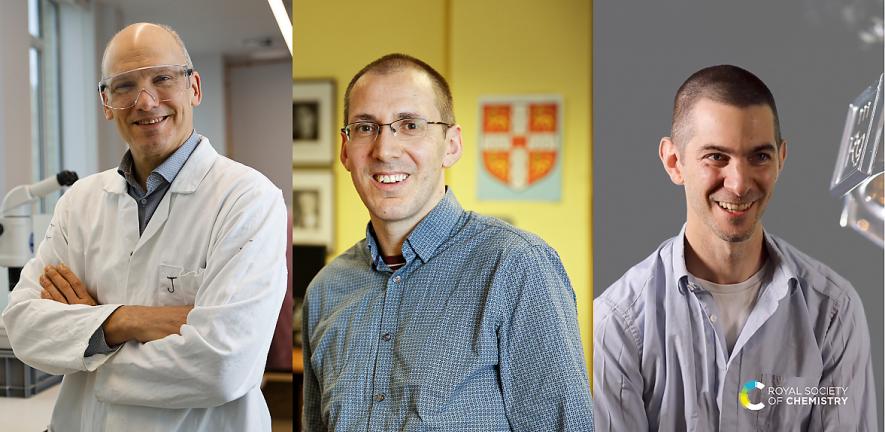
Professor Jonathan Nitschke and Professor Angelos Michaelides have received the RSC’s Tilden Prize for Chemistry, while Professor Hugo Bronstein has been named winner of the RSC’s Corday-Morgan Mid-Career Prize for Chemistry. These are the prestigious Research & Innovation Prizes of the Royal Society of Chemistry, awarded in recognition of exceptional individuals advancing the chemical sciences across industry and academia.
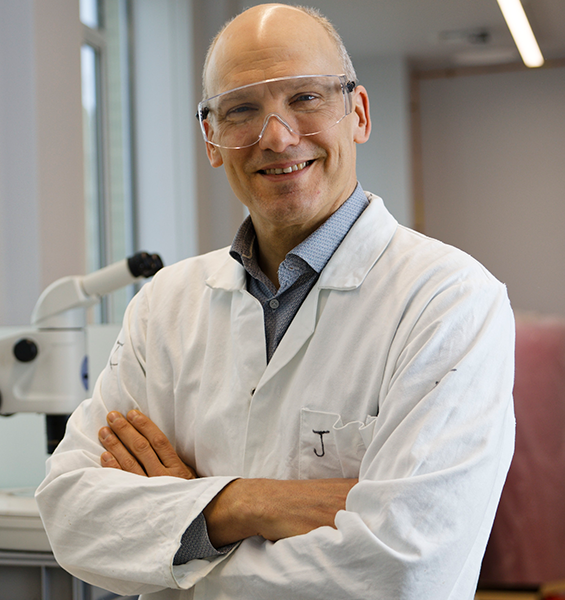
Professor Jonathan Nitschke has received the RSC’s Tilden Prize for the development of polyhedral metal−organic capsules as useful tools for chemical separations. His research group investigates the assembly of complex supramolecular structures from simple organic subcomponents and metal ions. The team has steadily increased the complexity of the metal–organic architectures they create, with a particular focus on hollow molecular containers capable of binding and transporting "guest" species. These systems have potential applications in chemical purification, sensing and molecular transformations.
On receiving the prize, Professor Nitschke said, "I'm tremendously honoured to accept this award on behalf of my research group. It is a testament to their hard work and creativity in designing and building new and useful polyhedral cages from metal ions and organic building blocks."
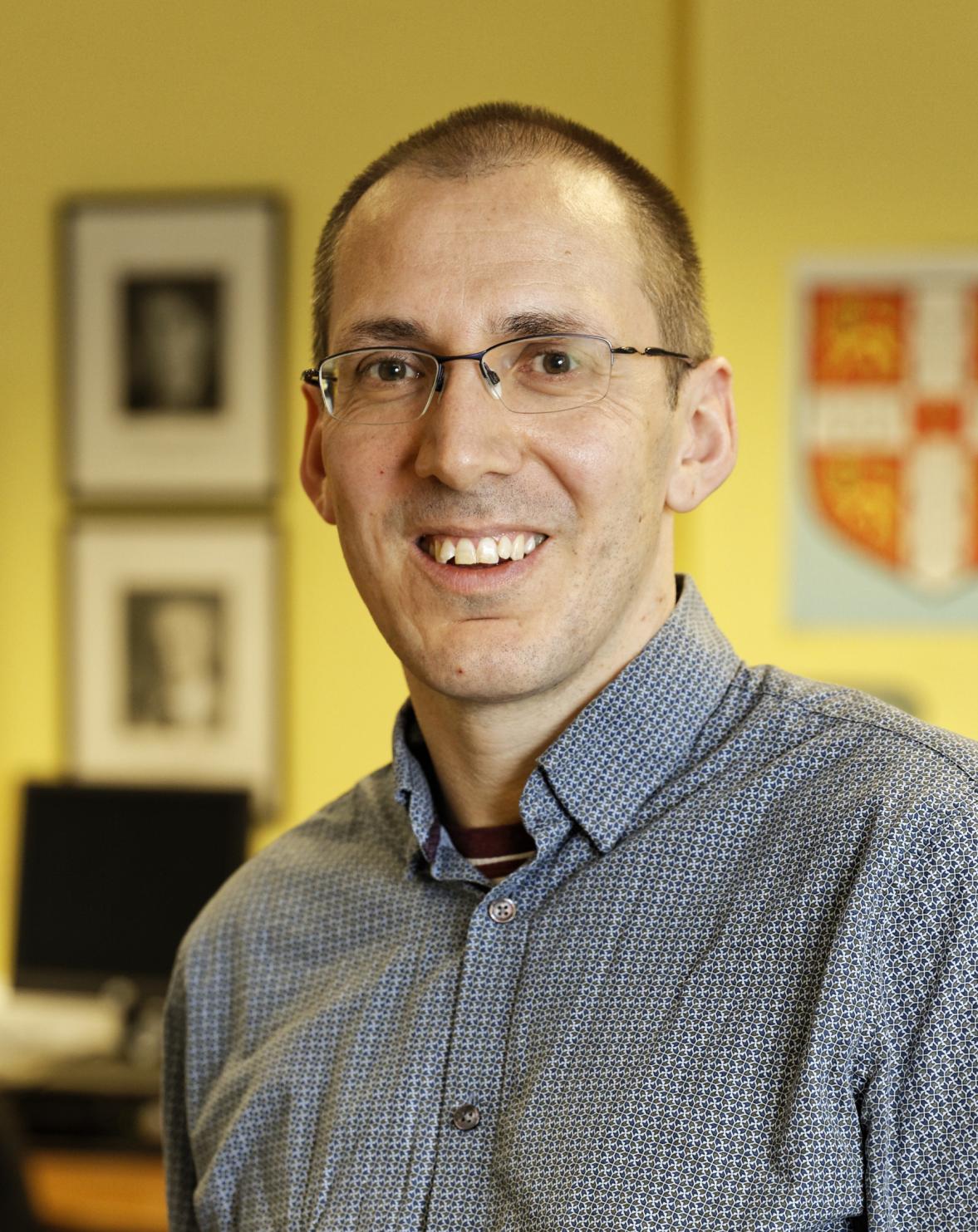 Professor Angelos Michaelides has received the RSC’s Tilden Prize for Chemistry for pioneering contributions to theoretical chemistry, including computational methods that provide mechanistic insight and predictive tools widely used in catalysis and surface science. His research group uses theory, computer simulation and artificial intelligence to understand how molecules behave on surfaces and in complex materials. Surfaces are where much of chemistry happens, controlling processes from catalysis and corrosion to energy conversion and materials growth. His group applies and develops advanced computational methods that combine quantum mechanics, statistical physics, and machine learning to create highly accurate virtual laboratories for exploring these processes in atomic detail.
On receiving the prize, Professor Michaelides said, “I’m delighted and very grateful to receive this prize. Although it has my name on it, all of my work is deeply collaborative, and this recognition really belongs just as much to the fantastic students, postdocs, collaborators and colleagues I’ve been lucky to work with over the years.”
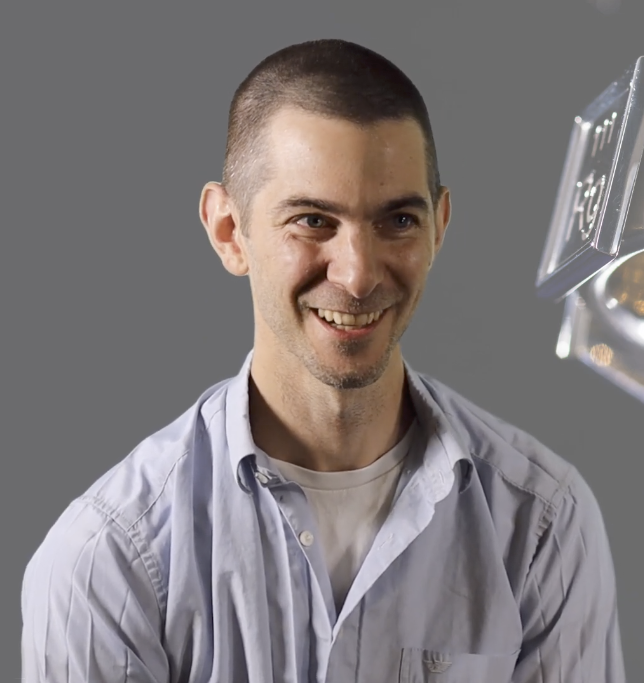 Professor Hugo Bronstein has received the RSC’s Corday-Morgan Mid-Career Prize for Chemistry, for the design, synthesis and understanding of functional organic materials with precisely controlled excited states. Research in Professor Bronstein's group involves the synthesis of new organic – i.e. carbon-based – materials for use in next generation technologies such as flexible solar panels, light emitting diodes, transistors and sensors.
He explains: "Traditionally, much of the development of new materials has come from a ‘top-down’ approach with a particular application focus. My aim as a scientist is to begin the research process from the ‘bottom up’. By developing a true understanding of how structure – both chemical and morphological – affects the fundamental properties, it will be possible to make rapid advances across all fields. In particular, using this approach I believe it is possible to make great advances in areas which I believe represent some key challenges for modern science – such as clean energy generation and quantum technologies."
On receiving the prize, Professor Bronstein said, “I am deeply grateful to my group members, mentors and collaborators past and present, without whom none of my research would have been possible. This prize means a great deal to me, as I have often felt somewhat of an outlier in the UK chemistry community: too ‘materials’ for organic chemistry and too ‘organic’ for materials chemistry. To receive this recognition feels like a welcome sense of acceptance, and perhaps reflects the growing permeability between traditional disciplines.”
Dr Helen Pain, CEO of the Royal Society of Chemistry, said, “Chemistry and chemists are everywhere in daily life and in our society, and our prizes reflect that depth and diversity. Our Research & Innovation prize winners include teams and individuals, professors and apprentices, as well as people from all around the world and in a wide range of roles and sectors. Each person’s contribution plays a vital role in advancing human knowledge and bettering the world that we all live in”.
They receive £5000 each, a medal and a certificate.
Find out more at rsc.li/prizes
The text in this work is licensed under a Creative Commons Attribution-NonCommercial-ShareAlike 4.0 International License.
Images, including videos, are Copyright © University of Cambridge and licensors/contributors as identified. All rights reserved. We make our image and video content available in a number of ways that permit your use and sharing of our content under their respective terms.
