
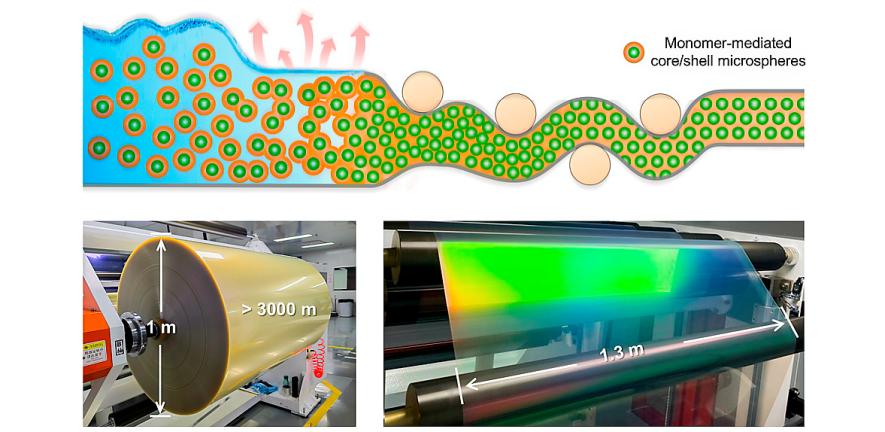
Recent research has revealed a new way to manufacture nature-inspired structural colour continuously and at room temperature, opening the possibility of producing vibrant, never-fading colour on films kilometres long.
An international team of researchers, including Professor Oren A. Scherman, Director of the Melville Laboratory for Polymer Synthesis at the University of Cambridge, and scientists from Fudan University, has developed a process that can produce structural colour in seconds rather than hours, overcoming a major challenge in scaling up these materials for practical applications.
The research, published in Science, provides a new route towards the rapid, continuous manufacture of photonic materials that recreate the vivid colours found in nature, including the iridescent blue of butterfly wings and the shimmering colours of opals.
Controlling disorder-to-order transitions at industrial scale has been a major challenge. The team’s breakthrough was surprisingly simple: adding small amounts of everyday chemical building blocks (monomers – the same kind used to make ordinary plastics) to a mixture of microscopic particles. With the right chemical "nudge", shear snaps the particles from disordered clumps into a well-ordered photonic structure that produces brilliant, non-fading colour. A quick flash of UV light then locks the pattern permanently in place.
“Simply applying more force was not the answer,” said Professor Changchun Wang of Fudan University, who co-led the research. “The important step was to control the interactions inside the material so that the particles could respond collectively to that force. That balance allows rapid ordering without sacrificing the quality of the final film.”
Because the process takes seconds and requires no heat or lengthy annealing, it overcomes a major limitation of previous approaches to manufacturing structural-colour films, which have required heat and time to produce the ordered structures. By removing this energy- and time-intensive step, the new process could significantly reduce manufacturing costs. The researchers built a continuous production line – much like a printing press – to produce the film non-stop.
"The challenge was to give the particles enough freedom to rearrange, but not so much that the ordered structure became unstable," said first author Dr Huateng Li of Fudan University. "Once we found the right formulation, the particles could snap into place almost instantly, just from a gentle shear."
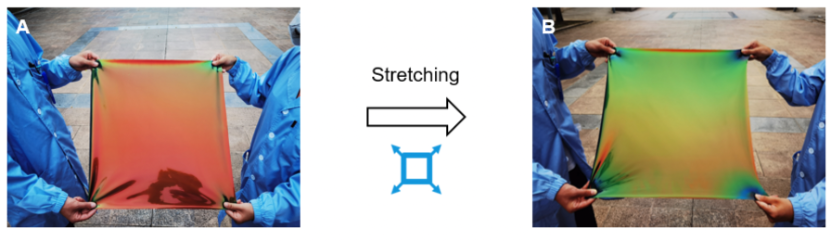
The team have produced rolls up to 4 kilometres long and 1.3 metres wide. At just 15 μm thick, the film is thinner than a human hair, 90% transparent outside its colour band and can stretch to twice its length without breaking. When cut, two edges pressed together will "heal" and regain their strength within a minute at room temperature – no glue required.
The manufacturing work was led by Dr Feng Tian, CEO of Phomera Metamaterials Inc., who completed his PhD in Professor Oren Scherman's group at the University of Cambridge from 2008–2012 before returning to China and co-founding the company to commercialise structural-colour materials.
"Making a great sample in the lab and making the same material continuously, at scale, are very different problems," said Tian. "We had to make the science work with the realities of a real production line, without losing any of the optical and mechanical properties."
The team are exploring applications including solar panels, where the film can add colour with minimal impact on power output, and sports tape, where its colour changes as it stretches, providing a visual indication of strain.
"What's exciting is the link between what's happening at the molecular scale and what we can now do across kilometres of material," said Professor Scherman, "This isn't just a lab trick - it's a genuine route to manufacturing nature's most striking colour effects on an industrial scale, for real-world products."
The researchers say the approach works across a wide range of everyday chemical ingredients and particle types, suggesting potential applications beyond this material.
The text in this work is licensed under a Creative Commons Attribution-NonCommercial-ShareAlike 4.0 International License.
Images, including videos, are Copyright © University of Cambridge and licensors/contributors as identified. All rights reserved. We make our image and video content available in a number of ways that permit your use and sharing of our content under their respective terms.
