

Chemists at the University of Cambridge have developed a new way to remodel amines – important chemical structures found in many medicines and biologically active molecules – by changing the connections between their atoms.
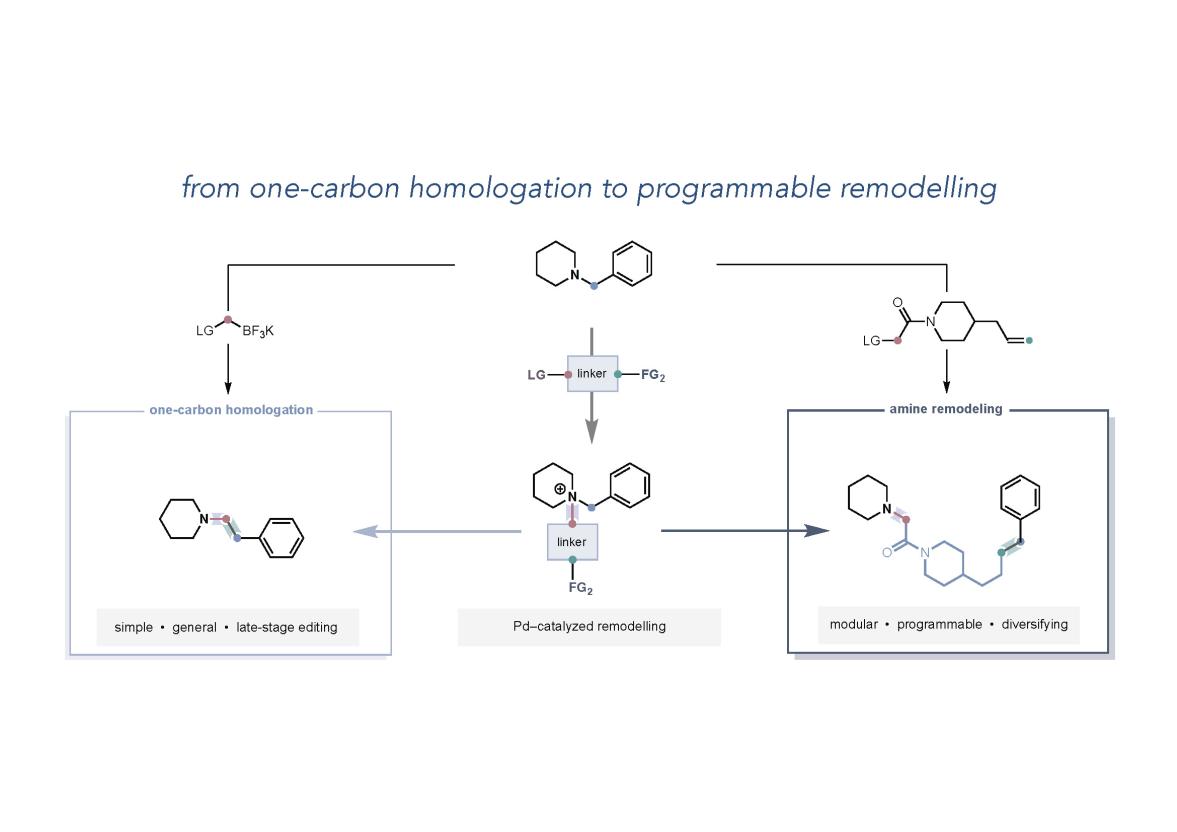
The approach, the result of research led by Professor Matt Gaunt and recently published in Nature, allows chemists to take an existing amine molecule and rebuild one of its carbon–nitrogen (C-N) bonds, inserting new molecular fragments in the process. This means that, rather than synthesising a new amine molecule from scratch, the method makes it possible to use an existing complex molecule as a starting point and directly alter its underlying architecture.
Amines are among the most common structural features in modern medicines. In particular, tertiary benzylamines are widely used in drug discovery because they can be readily assembled from simple chemical building blocks. Once made, however, their basic carbon–nitrogen framework is difficult to change. Chemists can modify the outer groups of these molecules, but changing the connectivity at their core has traditionally meant making an entirely new molecule.
The Cambridge team has developed a catalytic process that effectively unlocks this normally fixed C-N bond. The molecule is first converted into an intermediate that carries both the instructions and the molecular material needed for the subsequent transformation. A palladium catalyst then breaks and reconfigures the original connectivity, rebuilding the amine with a new structural unit inserted between its components.
In its simplest form, the reaction inserts a single carbon atom, converting readily available benzylamines into their one-carbon-longer counterparts. The researchers showed that the reaction could also be carried out directly on several complex pharmaceutical molecules, including donepezil, a drug used in the treatment of Alzheimer's disease.
More significantly, the same principle could be extended beyond single-carbon insertion. By changing the reagent used to programme the reaction, the researchers inserted longer carbon chains, oxygen-containing linkers, saturated rings and aromatic groups. Complex structural elements could therefore be introduced into an existing amine without having to reconstruct the molecule through a conventional multistep synthesis.
Professor Matthew Gaunt said: “We wanted to ask whether an amine really has to be regarded as a finished structure. Once you have made a complex molecule, its carbon–nitrogen connectivity is normally considered fixed. Our aim was to find a way to take that connection apart in a controlled manner and rebuild it with something new inserted in between.”
The method could be particularly useful in medicinal chemistry, where scientists routinely make families of related molecules to investigate how small structural changes affect biological activity. Changing the distance, shape or composition of the connection between an aromatic ring and an amine can have profound effects on molecular properties, but such changes can be difficult to explore using conventional synthesis.
The work establishes a broader concept of C–N bond remodelling, in which C-N bonds are treated not simply as connections to be made during synthesis, but as sites that can subsequently be reconfigured to explore new regions of chemical space.
The text in this work is licensed under a Creative Commons Attribution-NonCommercial-ShareAlike 4.0 International License.
Images, including videos, are Copyright © University of Cambridge and licensors/contributors as identified. All rights reserved. We make our image and video content available in a number of ways that permit your use and sharing of our content under their respective terms.
