

The Department is pleased to announce that Emeritus Professor Daan Frenkel ForMemRS is the latest recipient of the Tomassoni-Chisesi Physics Prize, an international award recognising outstanding achievements in physics – officially recorded in 2024 due to administrative delays.
The prize was presented by Professor Giorgio Parisi of the University of Rome “La Sapienza” on 18/3/2026. The funding for the prize was donated by Caterina Tomassoni and Felice Pietro Chisesi. It celebrates exceptional contributions to the field, regardless of nationality or where the research was carried out.
Professor Frenkel, winner in the over-40 category, is recognised for “fundamental insights in soft matter and the physics of phase transitions, using novel computational techniques and general models to describe entropy and free energies, and for his central role in building and shaping the computational physics community”.
A leading figure in computational chemical physics, Professor Frenkel’s work has transformed understanding of complex systems, with applications spanning materials science, chemistry and biology. His research has played a key role in advancing simulation methods that are now widely used across these fields.
It is the second time since 2001 that this prize was awarded to a scientist affiliated with a UK university. The first UK (and Cambridge) recipient was Professor Michele Vendruscolo, who received the prize in 2021.
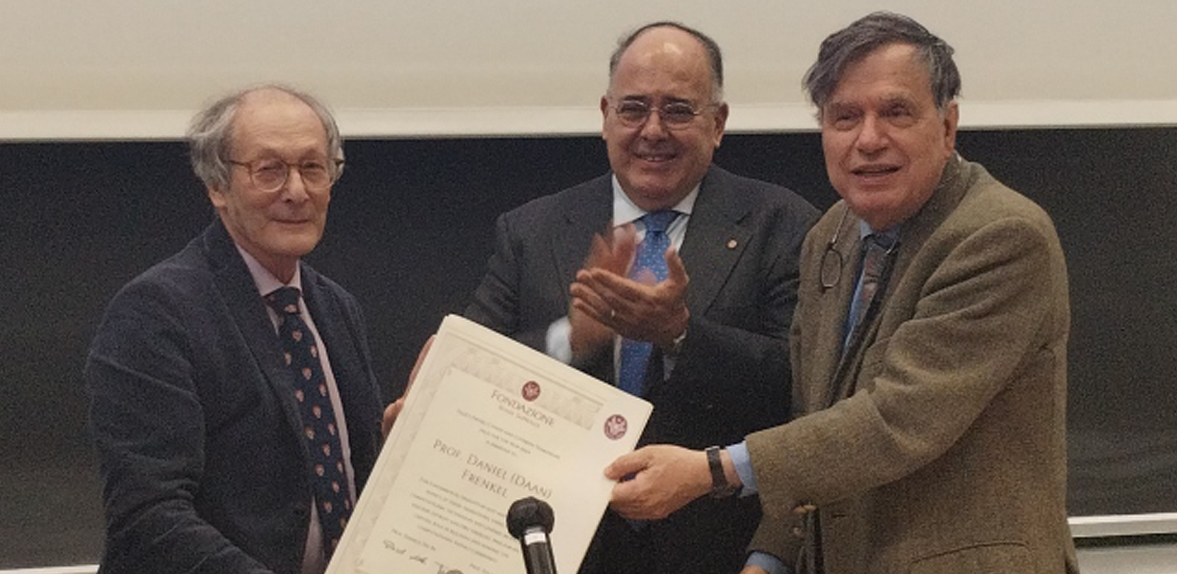
Daan (left) recieves the Tomassoni-Chisesi Physics Prize from Professor Giorgio Parisi (right).
Daan Frenkel added: “The over-40 prize tends to be given to scientists who are at a later stage of their career. In my case, it is even more extreme, as I should be in the over-75 category. Yet awards are most helpful for early and mid-career scientists. In Theoretical and Computational Chemistry, there is a scarcity of such awards: specifically, there is no longer a Theoretical/Computational Chemistry award in the UK, as the Royal Society of Chemistry has, since 2020, discontinued all its standalone awards in this area. Of course, Theoretical Chemists can still be honoured for their contribution to, say, Physical or Materials Chemistry. But the crucial technique developments that precede applications now fall through the cracks. Yet, younger UK theoretical chemists play a key role in the technique development in Theoretical and Computational Chemistry, not least in the area of machine learning.”
The text in this work is licensed under a Creative Commons Attribution-NonCommercial-ShareAlike 4.0 International License.
Images, including videos, are Copyright © University of Cambridge and licensors/contributors as identified. All rights reserved. We make our image and video content available in a number of ways that permit your use and sharing of our content under their respective terms.
