
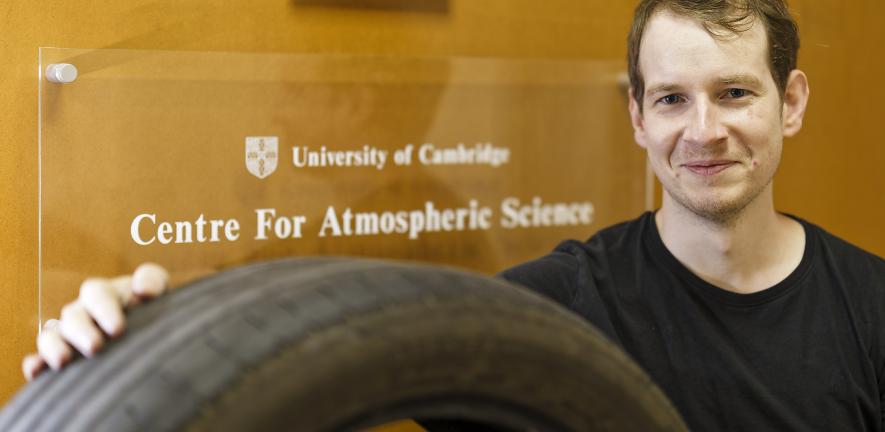
Siriel Saladin, working in the Giorio Group, has re-examined decades of laboratory and field studies on tyre wear emissions, an increasingly important area of research as exhaust emissions from road traffic continue to decline.
Tyre wear particles are generated as tyres degrade during driving and have long been considered a significant source of airborne particulate matter. However, this research shows that commonly used emission factors are systematically overestimated. Many of these values appear to stem from repeated misquotations across the scientific literature, leading to a persistent overstatement of their contribution to air pollution.
The findings suggest that most measured emission factors are up to an order of magnitude lower than widely cited estimates. The research also indicates that a substantial fraction of tyre-derived material does not become airborne, instead depositing close to roads as larger debris, with potential impacts on soils and water systems.
Following the evidence back to the source
One of the most frequently cited emission factors for airborne tyre wear is 13 mg PM10 per kilometre per vehicle, attributed to a Swiss study published in 2000. This value has been widely used in scientific literature, review articles and policy assessments.
However, Saladin found that the original publication did not estimate emission factors for airborne tyre wear emissions. He contacted the original study’s author, who confirmed that the origin of this widely cited value is unclear. This prompted a detailed investigation into the citation history of airborne tyre wear emission factors.
Inaccurate citation practices
The study identified several recurring issues in the literature, including confusion between tyre wear and road wear emissions, mixing of per tyre and per vehicle emission factors, inconsistent terminology for non-exhaust particle sources, and repeated reliance on secondary reviews rather than primary experimental studies.
According to Saladin, these issues contributed to an “illusion of truth”, whereby emission factors gained credibility through repeated citation despite limited empirical support.
In contrast, the study indicates that most primary experimental measurements of airborne PM10 tyre wear emissions are around or below 1 mg per kilometre per vehicle.
Policy relevance and impact
These results have been recognised by the Task Force on Emission Inventories and Projections TFEIP, which advises European policymakers, and which has highlighted the need to prioritise revision of current estimates. The findings have direct implications for emission inventories, air quality modelling and future research priorities.
Claims that electric vehicles may offer limited air quality benefits due to increased vehicle weight and associated tyre wear are also addressed in the study. The research suggests that some of these arguments rely on emission factors that can be traced through multiple layers of secondary references rather than primary measurements.
Improving the scientific record
More broadly, this work highlights the importance of transparent citation practices and careful verification of primary sources in environmental science.
By reconstructing the citation history of airborne tyre wear emission factors, Saladin provides a clearer understanding of how influential values became established and demonstrates how revisiting long standing assumptions can strengthen the evidence base used in air quality assessment and policy development.
Read more:
Publication: Airborne Tire Wear Particles: A Critical Reanalysis of the Literature Reveals Emission Factors Lower than Expected
The text in this work is licensed under a Creative Commons Attribution-NonCommercial-ShareAlike 4.0 International License.
Images, including videos, are Copyright © University of Cambridge and licensors/contributors as identified. All rights reserved. We make our image and video content available in a number of ways that permit your use and sharing of our content under their respective terms.
