
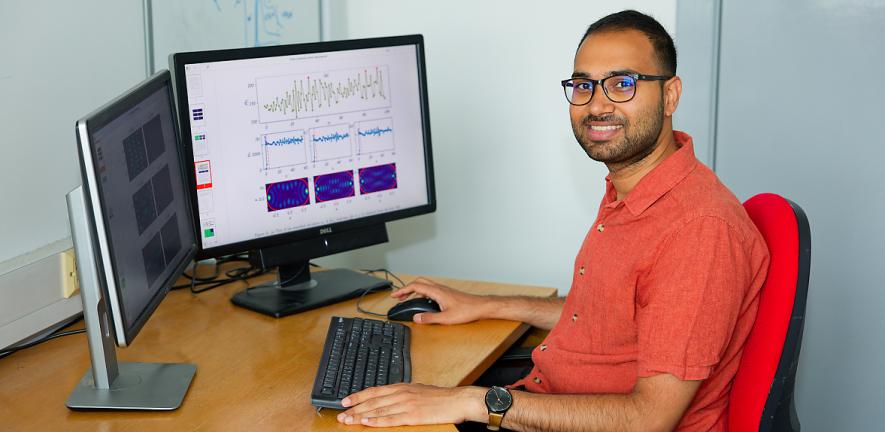
A new study led by Dr Vijay Ganesh Sadhasivam, recently published in Physical Review Letters, has revealed that quantum information can spread extremely quickly even in simple systems that are not chaotic, challenging a long-standing idea about how information moves through the quantum world.
The rate at which quantum information spreads over time has attracted considerable interest over the past decade, as it connects directly to the study of how information is stored and transported in quantum many body systems. Understanding how information spreads in quantum systems is important for developing future technologies, including quantum computers, where information needs to be stored, controlled, and processed reliably.
Scientists have previously believed that the fastest rates of quantum information spreading were mainly linked to chaotic systems, systems where small changes can lead to unpredictable behaviour. However, the research team, which includes Prof. Stuart Althorpe and Prof. Jan-Michael Rost from the Max Planck Institute for the Physics of Complex Systems in Dresden, found otherwise. "Our study reports that this is not necessarily the case: simple, non-chaotic quantum systems can also display exponentially fast information spreading. We connect this behaviour to certain properties of the experimental observable that quantifies the spread of information and hence reshape our understanding of what fast information spreading actually diagnoses," Vijay says.
The study also reveals that the apparent speed of information spreading depends not only on the quantum system itself, but also on what scientists choose to measure. For instance, measuring position rather than energy, or a single spin rather than a pair of spins, can change how fast the same system appears to spread information. This could help researchers identify promising quantum systems more quickly, reducing the time and effort needed to study potential technologies. Furthermore, the research could support a range of quantum platforms, including experiments using cold atoms and trapped ions, materials with adjustable magnetic properties, and future quantum computing hardware.
Overall, the research provides a new perspective on how information moves through quantum systems and could help scientists better understand and control it.
This work has been funded by the Leverhulme Trust and the Max Planck Society.
Read more:
Parker, D.E., Cao, X., Avdoshkin, A., Scaffidi, T. and Altman, E. (2019), 'A universal operator growth hypothesis', Physical Review X.
Maldacena, J., Shenker, S.H. and Stanford, D. (2016), 'A bound on chaos', Journal of High Energy Physics.
The text in this work is licensed under a Creative Commons Attribution-NonCommercial-ShareAlike 4.0 International License.
Images, including videos, are Copyright © University of Cambridge and licensors/contributors as identified. All rights reserved. We make our image and video content available in a number of ways that permit your use and sharing of our content under their respective terms.
