
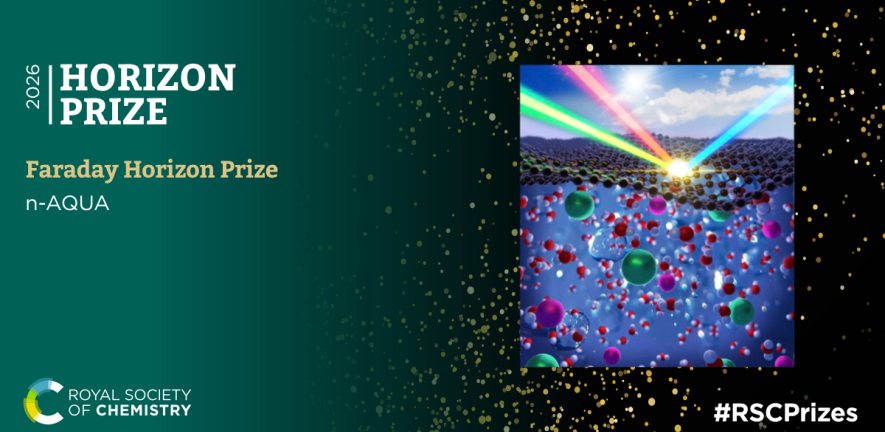
n-AQUA (nanoscale water), a major collaborative effort involving many of our researchers, has been awarded the Royal Society of Chemistry’s Faraday Horizon Prize. The prize recognises the team’s groundbreaking discoveries showing how water’s structure and behaviour change when it is confined to the nanoscale or interacts with low dimensional interfaces.
The project brings together scientists from the Max Planck Institute for Polymer Research in Mainz (MPI P), the CNRS and École Normale Supérieure – PSL in Paris (ENS PSL), and the University of Cambridge. As part of the award, the team received a trophy, a video highlighting their research, and individual recognition for each member.
The n-AQUA team, with support from the European Research Council, studies what happens to water when it is confined in spaces so small that only a few molecules can fit across. At this scale, water no longer behaves like the familiar liquid we encounter every day. It can flow in unexpected ways, reorganise its internal structure, and respond very differently to its surroundings.
To understand this, the collaboration combines three complementary approaches. They measure how water moves through extremely small channels, use advanced laser-based methods to probe how water molecules act at interfaces, and develop theoretical models that describe these behaviours at the atomic level. By bringing these perspectives together, n-AQUA can directly link how water flows with how it is structured and how its molecules interact collectively.
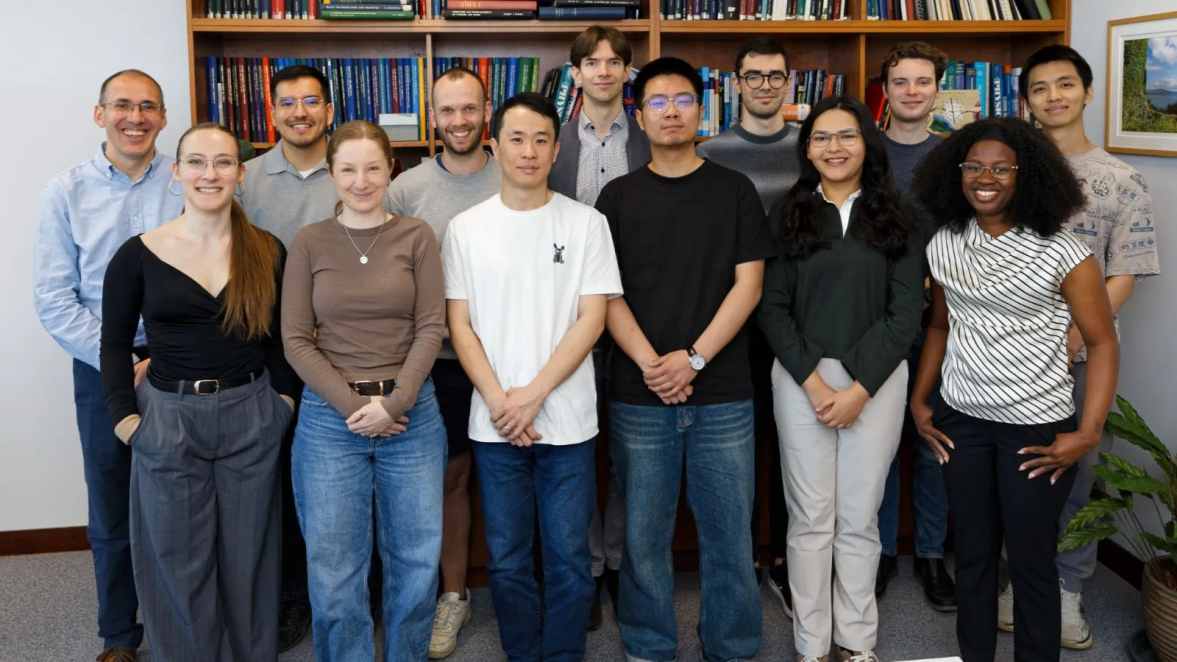
Some of the n-AQUA team at Cambridge: Front row from left: Mandy Hoffmann, Lisa Masters, Kaifeng Niu, Jiuyang Shi, Asmita Niyogi, IniOluwa Popoola. Back row from left: Angelos Michaelides, Xavier Rosas Advincula, Fabian Berger, Domantas Kuryla, Ioannis Karageorgiou, Hugo Rauch, Shu Yang. Image taken by Nathan Pitt ©University of Cambridge.
Professor Angelos Michaelides, who leads the team from the Yusuf Hamied Department of Chemistry at the University of Cambridge, comments: “We are delighted to have been recognised by the RSC in this way. I am particularly pleased that this award recognises the entire n-AQUA team as n-AQUA is fundamentally a joint team initiative. This recognition motivates us all to continue working together to understand and control the most important and scientifically fascinating of fluids."
As a result of this collaborative effort, 27 of our current and former researchers have been recognised:
Professor Angelos Michaelides
Assistant Professor Fabian Berger
Samuel Brookes
Anna T. Bui
Dr Samuel Coles
Dr Stephen J. Cox
Flaviano Della Pia
Dr Kara D. Fong
Mandy Hoffmann
Dr Venkat Kapil
Ioannis Karageorgiou
Giaan Kler-Young
Domantas Kuryla
Dr Timo Lebeda
Lisa Masters
Dr Kaifeng Niu
Asmita Niyogi
Niamh O'Neill
Alexandre Peuch
Inioluwa Popoola
Hugo Rauch
Xavier R. Advincula
Dr Christoph Schran
Benjamin Shi
Dr Jiuyang Shi
Eszter Varga-Umbrich
Shu Yang
Dr Helen Pain, CEO of the Royal Society of Chemistry, said, “The purpose of the Horizon Prizes is to recognise those who are pioneering new techniques, technologies, innovations and discoveries. They are a reflection of the worldwide impact and importance of the chemical sciences, and the ways in which individuals across the spectrum of chemistry-related roles, professions and sectors can come together and contribute their expertise to solving global problems.
“I extend my warmest congratulations to the members of n-AQUA. Winning an RSC Prize is a remarkable achievement. You join the ranks of a star-studded roster stretching back over 150 years, including several dozen who went on to win Nobel Prizes. Our winners are exceptional role models for our communities, and we’re so pleased to be celebrating such an extraordinary cohort this year.”
Read more here.
The text in this work is licensed under a Creative Commons Attribution-NonCommercial-ShareAlike 4.0 International License.
Images, including videos, are Copyright © University of Cambridge and licensors/contributors as identified. All rights reserved. We make our image and video content available in a number of ways that permit your use and sharing of our content under their respective terms.
