
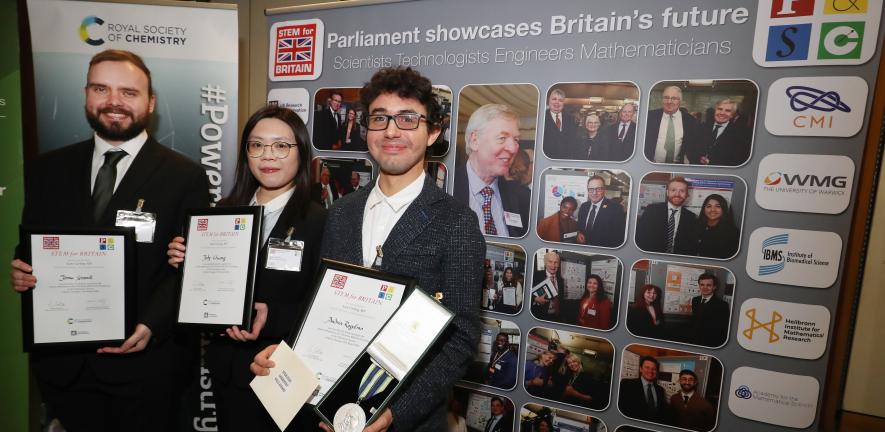
Andrea Rogolino, a final-year PhD student in the Reisner group, attended Parliament to present his chemistry research to a range of politicians and a panel of expert judges as part of the Parliamentary & Scientific Committee’s STEM for BRITAIN on 17 March.
His poster on research about solar-driven full valorisation of waste cooking oil was judged against dozens of other scientists’ research submission and he won the gold medal for his presentation in the Chemistry category. Andrea was shortlisted from hundreds of applicants to appear in Parliament. His research is published in Energy & Environmental Science.
The research
Andrea, who is also part of Downing College and supported by the Cambridge Trust, said: “It really put me out of my comfort zone. I like science communication and pushing myself to explain my research in an accurate and engaging way that anyone can understand. The experience was valuable and I’m very happy with the outcome.”
His research involves taking waste oil from diesel and turning it into valuable products using sunlight to power the process making the process cheap and sustainable. For the research, Andrea took waste cooking oil from a local college kitchen and converted it into useful chemicals with the only energy input being sunlight from the rooftop of the Yusuf Hamied Department of Chemistry.
Andrea adds: “Biodiesel is great because it is essentially a fuel for your car from waste cooking oil from your saucepan. However, there is still lack of attention to the leftovers of biodiesel production. Our discovery is especially relevant for the development of sustainable chemical industry, and for finding a solution to approach the Net Zero 2050 goal.”
In Parliament
On presenting his research in Parliament, Andrea said, “We scientists enjoy so much playing with our toys on the bench that we can easily forget that science does not end at the threshold of the laboratory. Science is all about understanding how the world around us works, and we have a responsibility to share our knowledge (and passion!) with that world outside. STEM for Britain is a wonderful opportunity to show everyone that science is not only useful, but also colourful and fun.”
Sam Carling MP, Chair of the Parliamentary and Scientific Committee APPG, said: “This annual competition is an important date in the parliamentary calendar because it gives MPs an opportunity to speak to a wide range of the country’s best young researchers. These early career engineers, mathematicians and scientists are the architects of our future and STEM for BRITAIN is politicians’ best opportunity to meet them and understand their work.”
The text in this work is licensed under a Creative Commons Attribution-NonCommercial-ShareAlike 4.0 International License.
Images, including videos, are Copyright © University of Cambridge and licensors/contributors as identified. All rights reserved. We make our image and video content available in a number of ways that permit your use and sharing of our content under their respective terms.
