
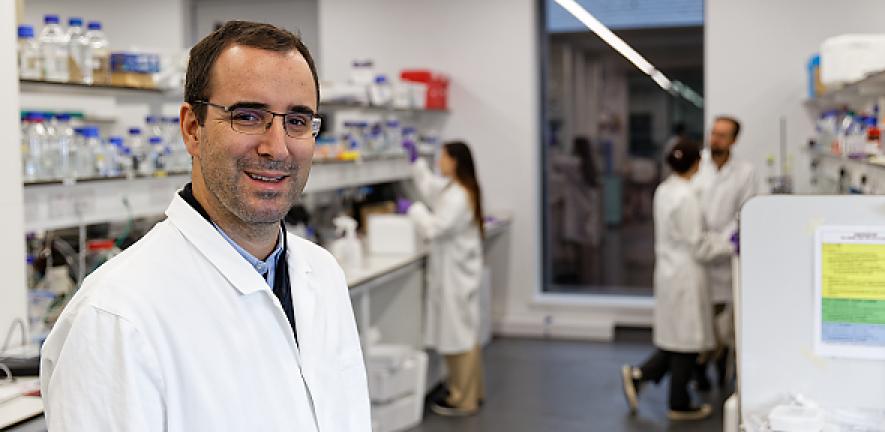
A University of Cambridge spinout co-founded by Professor Gonçalo Bernardes of the Yusuf Hamied Department of Chemistry has been selected to participate in a major Government-backed NHS trial investigating the potential of blood tests to detect cancer earlier.
Proteotype Diagnostics Ltd is among the companies chosen for the initiative, which will evaluate innovative blood-testing technologies in more than 20,000 patients across England, supported by £8.5 million in government funding.
The company's Enlighten® blood test (an in vitro diagnostic blood test) has been selected for evaluation in a dedicated randomised controlled trial, known as STRIDE-RCT, involving 4,000 participants.
Unlike conventional approaches that look for signs of cancer directly, Enlighten® identifies proteins in the blood that indicate an immune response to cancer. By detecting these biological signals, the test aims to help identify people who may have cancer, potentially enabling further investigations to begin sooner.
Professor Bernardes said, “Most of my career has focused on learning how to “write” site-specific modifications on proteins for therapeutic development; with Proteotype we use site-specific modifications in “reading” mode, to determine cancer proteomic changes.”
Dr Emma Yates, alumni from the Department of Chemistry and Proteotype CSO commented, “We convert an ensemble of chemical information from the immune response to tumour development within patient blood plasma into light signatures. We then use machine learning to convert these multidimensional light signatures into a cancer status prediction.”
The wider NHS initiative will evaluate blood tests capable of detecting signals associated with 13 types of cancer. As part of this, STRIDE-RCT will involve 4,000 participants across at least 200 GP practices in England, assessing whether the technology can provide GPs with additional information to identify patients who may need further investigation.
STRIDE-RCT marks the first time a Multi-Cancer Detection Test, such as Enlighten®, will be evaluated in and return results within primary care.
Importantly, a positive test result will not mean that a patient has cancer. Instead, it will provide an additional indicator to help GPs and patients decide whether an urgent referral for further diagnostic tests is appropriate.
From Cambridge research to potential NHS impact
The selection marks a significant milestone for Proteotype Diagnostics and highlights the potential of research emerging from the Yusuf Hamied Department of Chemistry to contribute to advances in healthcare.
The trial represents an important step towards understanding whether new approaches to blood-based cancer detection could complement existing diagnostic pathways and support efforts to identify cancer at an earlier stage.
Read more: Discover the research underpinning Proteotype Diagnostics' approach in Nature Communications.
The text in this work is licensed under a Creative Commons Attribution-NonCommercial-ShareAlike 4.0 International License.
Images, including videos, are Copyright © University of Cambridge and licensors/contributors as identified. All rights reserved. We make our image and video content available in a number of ways that permit your use and sharing of our content under their respective terms.
