
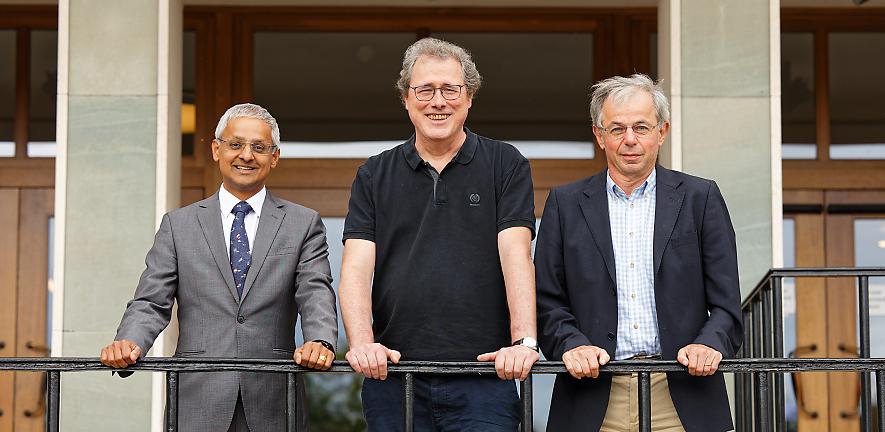
The Department is delighted to share the news that Prof. Sir Shankar Balasubramanian, Prof. Sir David Klenerman, and French biophysicist Prof. Pascal Mayer have been awarded the 2026 Princess of Asturias Award for Scientific and Technical Research for their work that transformed DNA sequencing.
Their research helped turn genome sequencing from a slow and expensive laboratory process into a fast and widely accessible technology that is now central to modern medicine.
The team developed what is known as next-generation DNA sequencing. This approach, often described as “massively parallel” sequencing, allows millions or even billions of DNA fragments to be read at the same time, rather than one after another. As a result, sequencing that once took months and cost millions of pounds can now be completed in hours or days for under a thousand dollars.
The impact has been wide-ranging. During the COVID-19 pandemic, these methods made it possible to quickly sequence the SARS-CoV-2 virus, helping scientists track new variants and speed up vaccine development. Today, the technology is used in cancer research, rare disease diagnosis, forensic science, and environmental studies, as well as large national genome projects.
Each scientist contributed different advances that made this possible. Balasubramanian’s work improved understanding of DNA chemistry and gene regulation. Klenerman developed advanced imaging techniques to observe biological processes at very high resolution. Mayer contributed innovations in DNA amplification and later work in biotechnology and AI-assisted drug discovery, helping make large-scale sequencing possible.
The award committee said “These breakthroughs have reshaped biology and medicine, opening up new fields such as microbiome research and making genetic testing increasingly routine in healthcare.
Next-generation sequencing is now considered one of the most important technologies in modern life sciences, changing how scientists study biology and how medicine diagnoses and treats disease.”
The award will be formally presented in October in Oviedo, Spain, in a ceremony attended by the Spanish royal family, alongside winners in arts, humanities, and international cooperation.
Prof. Shankar Balasubramanian said: “Writing from the University of Cambridge, I would like to express my deepest gratitude for this award, which I am truly honoured to receive.
The science and technology being recognised are the result of collective contributions from many brilliant people at the University of Cambridge, Solexa, Illumina, and Manteia, highlighting the importance of collaboration.
I would also like to thank the Princess of Asturias Foundation for recognising this work and for its important role in supporting science and technology.”
Read more here.
The text in this work is licensed under a Creative Commons Attribution-NonCommercial-ShareAlike 4.0 International License.
Images, including videos, are Copyright © University of Cambridge and licensors/contributors as identified. All rights reserved. We make our image and video content available in a number of ways that permit your use and sharing of our content under their respective terms.
