
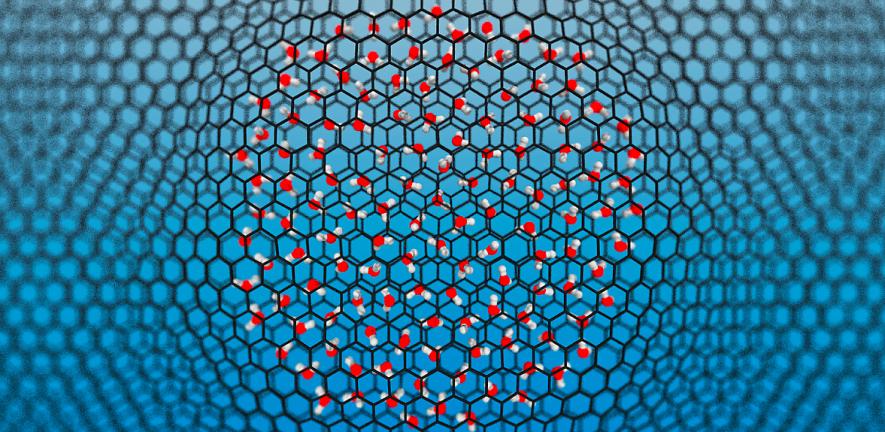
Scientists at Cambridge have helped resolve a long-standing question about how water behaves when confined to spaces just a few molecules wide, in work that could inform the design of batteries, fuel cells and nanofluidic devices.
The study, published in Science Advances, was led by Xavier R. Advincula, a PhD student in our department at Cambridge, the ICE Group, and the Cavendish Laboratory. The research was carried out as part of an international collaboration involving scientists from Harvard University, Caltech, and the Max Planck Institute for Polymer Research.
Water’s ability to split into charged species underpins pH and acid-base chemistry, but scientists have long debated whether this behaviour changes when water is confined within nanoscale pores, membranes and channels. In the new study, the researchers show that the chemistry of nanoconfined water is governed less by confinement itself than by pressure and the chemical nature of the surrounding material, helping to explain conflicting results from earlier studies.
“What surprised us most was how much of the apparent confinement effect could be explained by thermodynamics,” said Professor Angelos Michaelides, head of the ICE Group. “Once pressure and chemical potential are properly accounted for, a great deal of the complexity simply falls into place.”
Using machine-learning-based simulations, the team studied water trapped between atomically thin sheets of graphene and hexagonal boron nitride. They found that water confined in these nanometre-scale spaces can experience extremely high internal pressures, which strongly affect its reactivity. However, when compared with bulk water under the same thermodynamic conditions, the apparent effects of confinement largely disappeared.
“When we compared systems under equivalent thermodynamic conditions – specifically at the same chemical potential (the quantity that determines whether a reaction proceeds), the effect of confinement largely disappeared,” said Xavier R. Advincula. “In other words, confinement alone does not intrinsically change water’s reactivity. This helps explain why experiments over the past decade have produced contradictory results.”
The researchers also found that the confining material can actively influence water chemistry. In water droplets encapsulated within hexagonal boron nitride, hydroxide ions formed at the droplet edges bond to the surrounding material, stabilising them and making water splitting easier. The findings provide a new framework for understanding water chemistry at the nanoscale and could help guide the design of technologies that rely on confined water.
Read the Cavendish Laboratory news here
Watch a related video here
The text in this work is licensed under a Creative Commons Attribution-NonCommercial-ShareAlike 4.0 International License.
Images, including videos, are Copyright © University of Cambridge and licensors/contributors as identified. All rights reserved. We make our image and video content available in a number of ways that permit your use and sharing of our content under their respective terms.
