
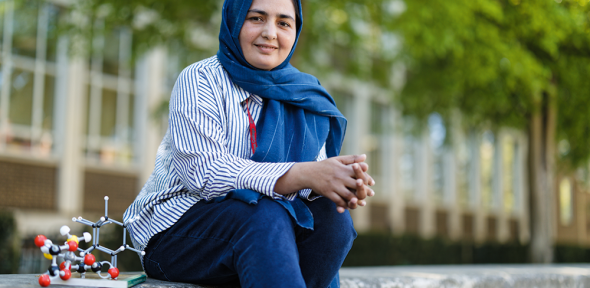
Amna Bibi is a PhD student in the Wheatley group specialising in metal-organic frameworks (MOFs). She is the first female student from Bannu, Pakistan, to come to the University of Cambridge to study chemistry.
Research in MOFs
These materials have a highly porous structure, meaning that they can absorb and hold molecules inside them, similar to a sponge. Because of this property, they are very useful for applications in catalysis and environmental chemistry. In her work, Amna designs MOF-based catalysts that use light energy to convert carbon dioxide into useful products such as methane, methanol or ethanol, which can potentially be used in energy and industrial applications.
Amna says: “One of the major challenges the world faces today is the increasing levels of carbon dioxide in the atmosphere, which contributes to global warming and climate change. At the same time, there is a growing need for sustainable and alternative energy sources. My research aims to address both of these challenges simultaneously by developing materials that can mimic natural photosynthesis—the process plants use to convert carbon dioxide and sunlight into energy-rich molecules.”
Unusual route to chemistry
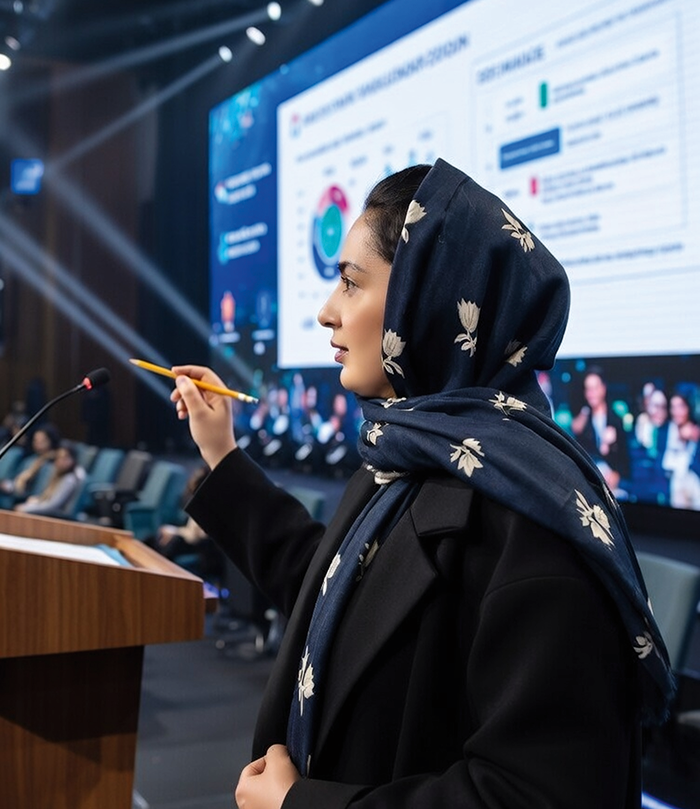 During her master’s research at the University of Science and Technology, Bannu, Amna realised that her work could solve real-world problems such as environmental issues and energy challenges. She wanted to pursue this sense of contributing to science with a PhD.
“My interest in chemistry began in an unusual way. When I was in secondary school, chemistry was actually one of the most difficult subjects for me. However, I have always been curious about things that I find challenging and, instead of avoiding the subject, I tried to explore it more deeply, and that turned into genuine interest.”
From Pakistan to Cambridge
Amna says: “Moving from my hometown of Bannu in Pakistan to Cambridge was a complete transition. Coming from a remote area with limited technology and a very social culture, I entered a world that felt almost like an English movie—everything was new and fascinating. The labs were fully equipped, the work culture was highly structured, and even daily life, from dress and food to social interactions, was very different.”
Amna credits her journey in chemistry to the strong support of her husband, Syed, who encouraged her to study at Cambridge. Although she had to leave her two young daughters in Pakistan due to financial constraints, she ensured they remained in a loving, stable environment—cared for by her husband and her mother—allowing her to pursue her ambitions with confidence and serenity.
She says: “Syed shared household responsibilities, believed in my potential, and encouraged me to follow my ambitions. His support allowed me to overcome personal and societal challenges and continue on this path, achieving goals I once thought were beyond my reach. I carry the emotional weight of being away from my children. I’m proud to pursue my dreams at Cambridge—an opportunity I worked hard for—yet I feel the distance from my family. I trust this sacrifice will give my daughters a better future.”
Amna concludes, “Women in STEM still face several barriers, including limited encouragement, fewer role models, and restricted access to mentorship or research opportunities. Additionally, many institutions lack sufficient resources, such as well-equipped laboratories, instruments, and funding, which affects both women and men. The biggest difference could come from improving infrastructure, providing guidance and mentorship, and creating supportive environments that foster participation in STEM.”
