

Professor of Chemistry
What we do...
We are designing hollow supramolecular capsules or ‘cages’, which can be used to transport cargoes of molecules where we need them. These cages could be used to safely deliver drug therapies, reduce the costs and environmental effects of petroleum refining, and in many other areas.
Figuring out the rules
We are interested in discovering and developing new ways in which simple building blocks may be induced to self-assemble into complex, functional structures. Our investigations currently focus upon the self-assembly of imine bonds around metal-ion templates, bringing both covalent C=N and coordinative N→Metal bonds into being during the same overall self-assembly process. The structures thus created can rearrange in well-defined ways at both covalent and coordinative linkages. Ongoing projects include:
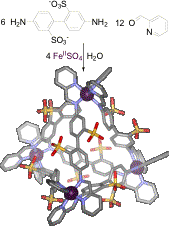
Container Molecules. The diamine and aldehyde shown above self-assemble with iron(II) in water to form a tetrahedral cage. This cage traps guest molecules within its cavity with high selectivity. The cage may be opened and the guest released using different triggers, one of which is a drop in pH. Applications in drug delivery are of interest, as are investigations of changes in the reactivity and behaviour of guest molecules upon encapsulation.
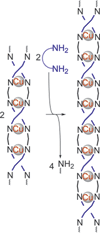
Functional Materials. We have recently developed means to create metal-containing conjugated polymers through self-assembly. DFT calculations carried out by Laura Gagliardi and Christopher Cramer suggest that these might conduct electricity. Studies are thus being undertaken to investigate their properties.
Watch Professor Nitschke discuss his research
Take a tour of the Nitschke Lab
Selected Publications
Feature Article: “Metal-organic container molecules through subcomponent self-assembly”, T.K. Ronson, S. Zarra, S.P. Black, J.R. Nitschke, Chem. Commun. 2013, 49, 2476-2490.
“Enantiopure Water-Soluble Fe4L6 Cages: Host-Guest Chemistry and Catalytic Activity”, Jeanne L. Bolliger, Ana M. Belenguer, and Jonathan R. Nitschke, Angew. Chem. Int. Ed. 2013, 52, 7958-7962.
“Aqueous Self-assembly of an Electroluminescent Double-helical Metallo-polymer”, X. de Hatten, D. Asil, R.H. Friend, J.R. Nitschke, J. Am. Chem. Soc. 2012, 135, 19170-19178.
“Anion-induced Reconstitution of a Self-assembling System to Express a Chloride-binding Co10L15 Pentagonal Prism”, I.A. Riddell, M.M.J. Smulders, J.K. Clegg, Y.R. Hristova, B. Breiner, J.D. Thoburn, J.R. Nitschke, Nature Chem. 2012, 51, 751-756.
“White phosphorus is air-stable within a self-assembled tetrahedral capsule” P. Mal, B. Breiner, K. Rissanen and J.R. Nitschke, Science 2009, 324, 1697-1699.
“Systems chemistry: Molecular networks come of age” J.R. Nitschke, Nature 2009, 462, 736-738.
Publications
- 1 of 40