

Professor of Chemistry and Bio-materials
Photonic structures in Nature and Bio-mimetic Materials
Research Interests
Photonic structures in nature
Colour in nature is everywhere: animals and plants develop structures on sub-micrometer scale to manipulate light and to obtain brilliant and iridescent colours. This kind of colouration, named structural since it is not obtained using pigmentation, results from various mechanisms, including multilayered materials, crystalline inclusions and surface diffraction gratings. Pollia condensata fruits are one of the most striking examples of strong iridescent colouration in plants. The colour is caused by Bragg-reflection of helicoidally stacked cellulose microfibrils, which form multilayers in the cell walls of the epicarp. The bright blue colour of this fruit is more intense than that of many previously described biological materials. Uniquely in nature, the reflected colour differs from cell to cell, as the layer thicknesses in the multilayer stack vary, giving the fruit a striking pixelated or ’pointillist’ appearance.
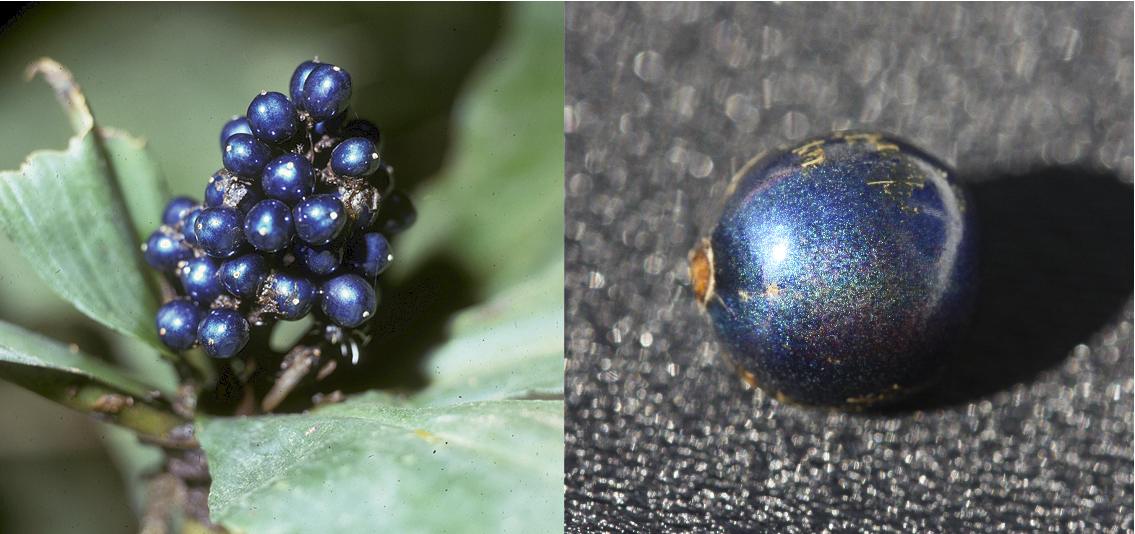
PNAS 109, 15712–15715, (2012)
Another striking example is the white of the Cyphochilus beetle which is native to South-East Asia, is whiter than paper, thanks to ultra-thin scales which cover its body. A new investigation of the optical properties of these scales has shown that they are able to scatter light more efficiently than any other biological tissue known, which is how they are able to achieve such a bright whiteness.
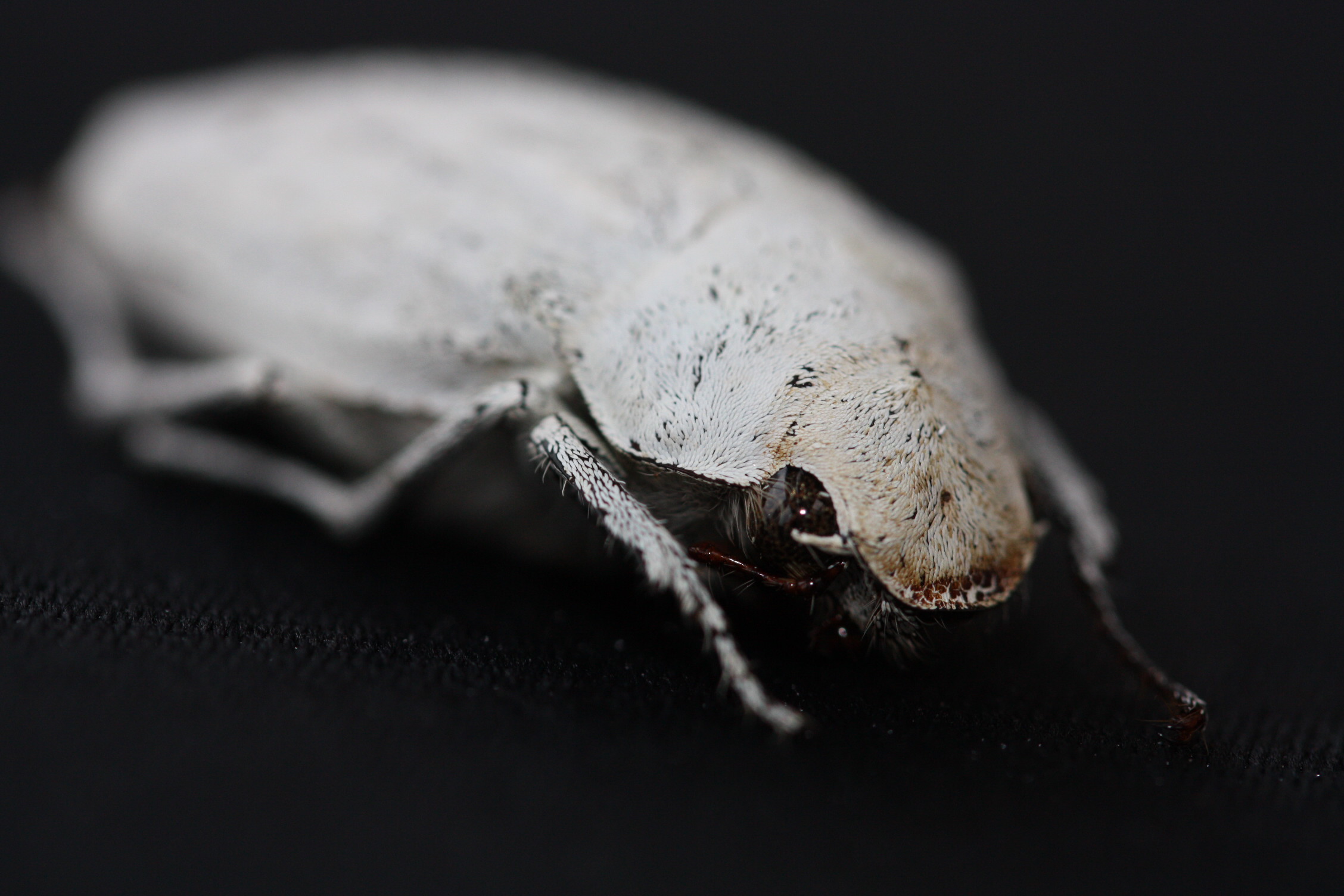
Scientific Reports 4, 6075 doi:10.1038/srep06075 (2014)
Funding
- BBSRC David Phillips fellowship
- Next Generation fellowship
- Isaac Newton Trust
Watch Professor Vignolini discuss her research
Take a tour of the Vignolini lab
Selected Publications
[1] Pointillist structural colour in Pollia fruit
S. Vignolini, P. J. Rudall, A. V. Rowland, A. Reed, E. Moyroud, R. B. Faden, J. J. Baumberg, B. J. Glover, U. Steiner; PNAS 109, 15712–15715, (2012).
[2] Controlled bio-inspired self-assembly of cellulose-based chiral reflectors
[3]Bright-White Beetle scales Optimise Multiple Scattering of Light
M. Burresi, L. Cortese, L. Pattelli, M. Kolle, P.Vukusic, D. Wiersma, U. Steiner, and S.Vignolini; Scientific Reports 4, 6075 doi:10.1038/srep06075 (2014)
Publications
- Page 1
