

Director of Research
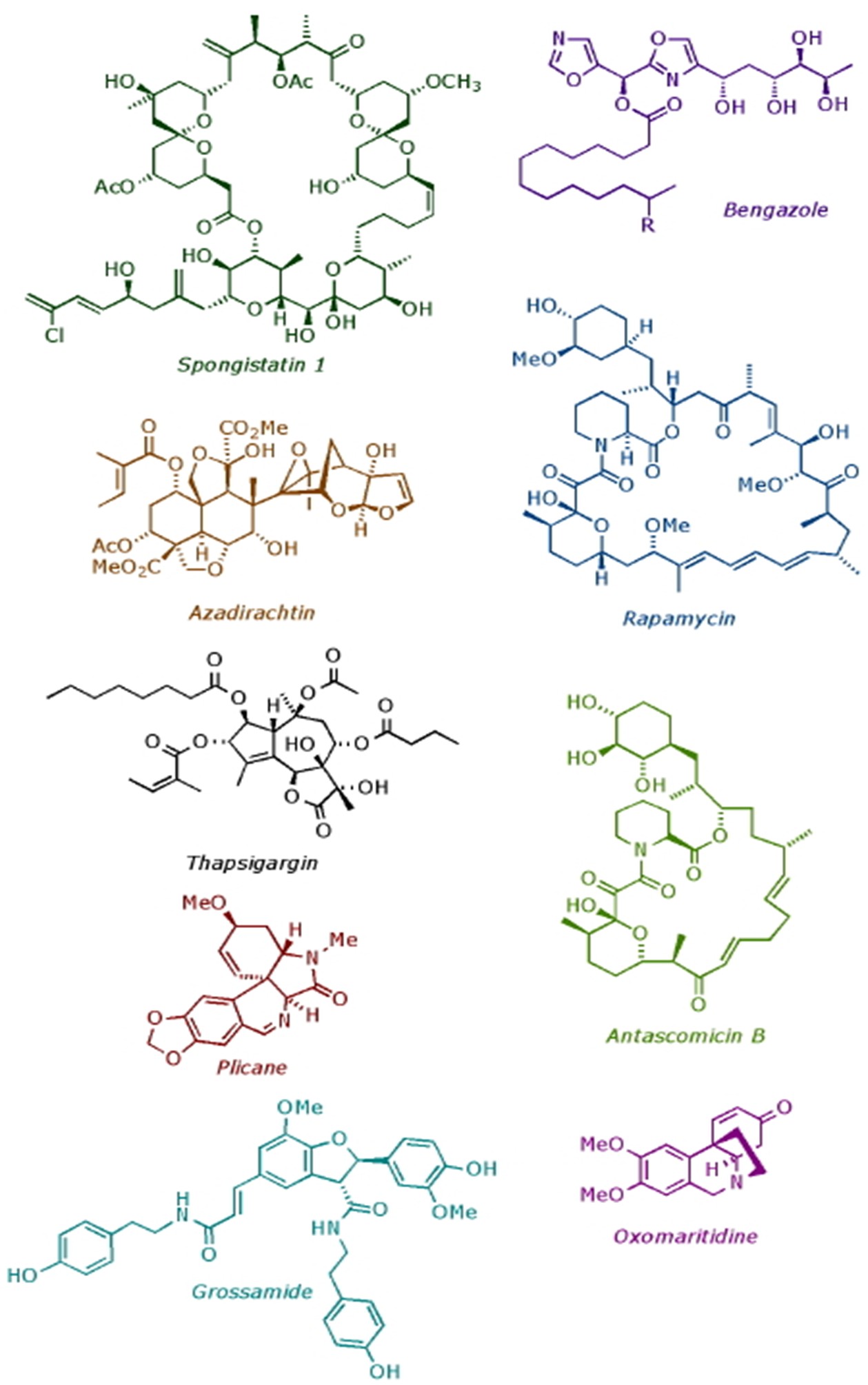
In the Ley Group, we specialise in developing new synthesis methods and applying them to the construction of biologically important molecules. Over the years we have completed the total synthesis of many natural products, including: spongistatin 1 (anti-mitotic agent); rapamycin (immunosuppressant); thapsigargin (SERCA pumps inhibitor); azadirachtin (insect antifeedant); and bengazole A (fungicide). In addition to our research on natural product synthesis, we also pioneered flow chemistry and machine assisted synthesis.
For more detailed research information and our publication list, please see our legacy group website.
Completed Natural Products
Publications
Chromatography-free Suzuki reactions using a polymer-assisted solution-phase (PASP) approach
Synlett
(2007)
2007
1251
(doi: 10.1055/s-2007-977457)
A microcapillary flow disc reactor for organic synthesis
Organic Process Research and Development
(2007)
11
399
(doi: 10.1021/op700015f)
Tagged phosphine reagents to assist reaction work-up by phase-switched scavenging using a modular flow reactor.
Organic & biomolecular chemistry
(2007)
5
1562
(doi: 10.1039/b703033a)
[3+27] Cycloaddition of acetylenes with azides to give 1,4-disubstituted 1,2,3-triazoles in a modular flow reactor
Organic & biomolecular chemistry
(2007)
5
1559
(doi: 10.1039/b702995k)
A fascination with 1,2-diacetals
The Journal of Organic Chemistry
(2007)
72
5943
(doi: 10.1021/jo0703451)
Continuous flow ligand-free heck reactions using monolithic Pd [0] nanoparticles
Organic Process Research and Development
(2007)
11
458
(doi: 10.1021/op7000436)
Natural product synthesis: A stimulus for discovery
ABSTR PAP AM CHEM S
(2007)
233
Influence of microwave irradiation on the reaction of MgO and Al2O3 slurries to form layered double hydroxide
ABSTR PAP AM CHEM S
(2007)
233
205
Design and total synthesis of unnatural analogues of the sub-nanomolar SERCA inhibitor thapsigargin
Organic & biomolecular chemistry
(2007)
5
1427
(doi: 10.1039/b702481a)
Optimisation of Conditions for O‐Benzyl and N‐Benzyloxycarbonyl Protecting Group Removal using an Automated Flow Hydrogenator
Advanced Synthesis and Catalysis
(2007)
349
535
(doi: 10.1002/adsc.200600558)
- ‹ previous
- Page 39
