
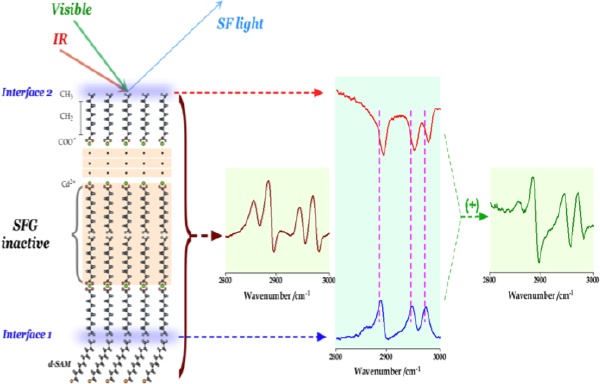
Laser Spectroscopy has revolutionised the determination of molecular structure. The Cambridge Infrared Laser Spectroscopy Group uses a variety of novel laser based techniques to study molecules in situations as diverse as low pressure electric discharges (plasmas) and on surfaces buried under liquids. The shapes of short lived molecules like free radicals and ions are precisely determined using solid state diode lasers in combination with sensitive, species- specific detection methods like Velocity Modulation. Recent diode laser spectroscopy of free radicals has included measurement of the band strength of the methyl radical, CH3. This is required for detection and density measurements of CH3 in the atmospheres of the giant planets Saturn and Neptune. We are now enhancing the sensitivity of IR laser absorption spectroscopy in a fruitful collaboration with German colleagues using a Cavity Ring Down (CRD) spectrometer built around novel Quantum Cascade Lasers. The group is also heavily involved in non linear laser spectroscopy particularly the interface specific technique of Sum Frequency Generation (SFG). We use SFG to gain insight into adsorption at interfaces on a molecular scale e.g. of surfactants and polymers. We use nano and picosecond lasers for SFG in Cambridge and femtosecond SFG to quantify non linear optical effects in Langmuir Blodgett films in a joint project with co-workers in Hokkaido, Japan. The aim is eventually to use SFG to study biological systems like the lung surfactants. In addition to our international projects, which involve overseas visits by our research students, much of our work on surfaces and interfaces is strongly supported by industry.
Publications
- ‹ previous
- Page 18
