

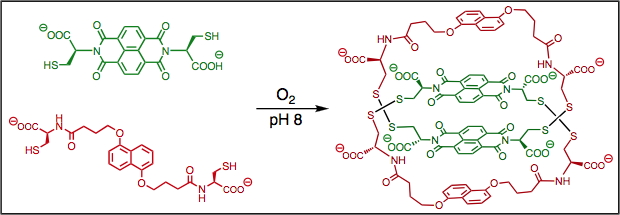
We are interested in molecular recognition, aiming to uncover and exploit the rules governing non-covalent interactions. Hydrophobic, π–π, donor–acceptor, metal– ligand and hydrogen bonding interactions are used to create new supramolecular systems that expand our understanding of molecular behaviour and may have useful recognition, catalytic or photophysical properties. In particular in the past few years we have developed the concept of dynamic combinatorial chemistry as a new approach for discovering entirely unexpected structures and assemblies. Over the years our building blocks have included peptides, metalloporphyrins, steroids and simple aromatics, and our products have included macrocycles, rotaxanes, catenanes, molecular knots and supramolecular nanotubes. Very recently, while investigating dynamic chemistry in the solid state using ball mill grinding, we have discovered solvent and surface effects on polymorph stability in nanocrystals

Please note that I am not taking any new students or postdocs into my research group.


Selected Publications


Evolution of dynamic combinatorial chemistry, Accounts Chem. Res., (2012), 45, 2211.

Discovery of an organic trefoil knot, Science, (2012), 338, 783.

Templated dynamic synthesis of a [3]Catenane, Angew. Chemie Intl. Edn., (2012), 51, 1443.

Thermodynamics of supramolecular naphthalenediimide nanotubes, J. Am. Chem. Soc., (2012), 134, 566.

Discovery of linear receptors for multiple dihydrogen phosphate ions using dynamic combinatorial chemistry, J. Am. Chem. Soc., (2011), 133, 3804.

Formation pathways of Donor-Acceptor catenanes in aqueous dynamic combinatorial libraries, J. Am. Chem. Soc., (2011), 133, 3198.

Solid-state dynamic combinatorial chemistry, Chem. Sci., (2011), 2, 696.

An unexpected receptor for C70, Angew. Chemie Intl. Edn., (2008), 47, 2689.

Publications

Nuclear magnetic double resonance; the use of difference spectroscopy
JKM Sanders, JD Mersh
Progress in Nuclear Magnetic Resonance Spectroscopy
(1982)
15
The solution conformation of 17α-acetoxy-6α-methylprogesterone (‘medroxyprogesterone acetate’) : use of circular dichroism, nuclear overhauser effect difference and two-dimensional J spectroscopy
MW Barrett, RD Farrant, DN Kirk, JD Marsh, JKM Sanders, WL Duax
J. Chem. Soc., Perkin Trans. 2
(1982)
CITATION CLASSIC - A SHIFT-REAGENT FOR USE IN NUCLEAR MAGNETIC-RESONANCE SPECTROSCOPY - A 1ST-ORDER SPECTRUM OF N-HEXANOL
JKM SANDERS
CC/PHYS CHEM EARTH
(1982)
The suppression of Bloch-Siegert shifts and subtraction artifacts in double-resonance difference spectroscopy
JD Mersh, JKM Sanders
Journal of Magnetic Resonance 1969
(1982)
50
Isolation and structure determination of norditerpene dilactones from Podocarpus saligna D. Don
SA Matlin, MA Prazeres, JD Mersh, JKM Sanders, M Bittner, M Silva
Journal of the Chemical Society, Perkin Transactions 1
(1982)
Quinone-capped porphyrins: N.M.R. studies of static and dynamic stereochemistry and co-ordination properties
KN Ganesh, JKM Sanders, JC Waterton
Journal of the Chemical Society Perkin Transactions 1
(1982)
Preferred conformations of enol ethers in solution: Detection of an equilibrium by kinetic nuclear overhauser effects
JD Mersh, JK Sanders
Tetrahedron Letters
(1981)
22
Spin-echo methods for resolution control of lanthanide-shifted n.m.r. spectra
JM Bulsing, JKM Sanders, LD Hall
Journal of the Chemical Society, Chemical Communications
(1981)
“In beam” electron impact mass spectrometry: the structure of a bacteriochlorophyll allomer
RG Brereton, V Rajananda, TJ Blake, JKM Sanders, DH Williams
Tetrahedron Letters
(1980)
21
Petroporphyrins IV. Nuclear overhauser enhancement 1H NMR studies of deoxophylloerythroetio porphyrins from gilsonite
JME Quirke, JR Maxwell, G Eglinton, JKM Sanders
Tetrahedron Letters
(1980)
21

Research Group

Telephone number

01223 336411

Email address