

Our main interest is in the relationship between the structure and properties of solids. We study the geometric reasons for the chemical activity of solids and the relationship between local order and physical properties, using mathematical techniques and computer graphics. We use solid-state nuclear magnetic resonance spectroscopy (NMR) to examine molecular sieves, minerals, layered materials, fullerenes, ceramics and biological materials.
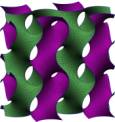
The G minimal surface divides space into two interpenetrating labyrinths (coloured red and green).
Specific projects:
- Periodic minimal surfaces (surfaces with zero mean curvature), which appear in a variety of inorganic, organic and biological structures, and the associated mathematical problems.
- Morphogenesis (the origin of shape and form).
- Systematic enumeration of crystalline networks using mathematical tiling theory.
- Graphite, graphite oxide and graphene.
- Synthesis and characterization of microporous and mesoporous molecular sieves.
- Synthesis and characterization of metal-organic frameworks (MOFs).
Selected Publications
Hypothetical zeolitic frameworks: In search of potential heterogeneous catalysts. J. Phys. Chem. 112, 1040 (2008)
Low-temperature thermal decomposition of large single crystals of ammonium perchlorate. Chem. Phys. Lett. 454, 233 (2008)
Simulating self-assembly of ZnS nanoparticles into mesoporous materials. J. Am. Chem. Soc. 128, 15283 (2006)
Cross-polarization in the solid state. A guide for chemists. Chem. Rev. 102, 613 (2002)
Synthesis and characterization of a new layered compound of trimesic acid. New Journal of Chemistry 26, 381 (2002)
Exact computation of the triply periodic G ('gyroid") minimal surface. Chem. Phys. Lett. 321, 363 (2000)
Systematic enumeration of crystalline networks. Nature 400, 644 (1999)
Structural studies of tabasheer, an opal of plant origin. Phil. Mag. A 77, 201 (1998)
Structure of graphite oxide revisited. J. Phys. Chem. B102, 4477 (1998)
Solid-state NMR studies of fullerene C60/benzene solvates. J. Phys. Chem. B101, 117 (1997)
New rapidly convergent series representations for z (2 n + 1). Proc. Am. Math. Soc. 125, 1263 (1997)
Directing the pore dimensions in the mesoporous molecular sieve MCM-41. Chem. Phys. Lett. 263, 247 (1996)
Taboo Search: an approach to the multiple-minima problem. Science, 267, 664 (1995)
Publications
- ‹ previous
- Page 43
