

PLEASE NOTE: Professor Clarke will be retiring at the end of September 2017 and therefore is not accepting any further applications.
Biophysical and structural studies of protein folding
The physics and chemistry of weak molecular interactions underpin the whole of biology. These determine the structure and stability of biological macromolecules and the strength and lifetime of interactions of these macromolecules with other cellular components. Understanding how a protein folds into a specific structure (which is only marginally stable) on a biologically relevant timescale, is still a significant challenge. Fundamental biophysical studies of the folding of proteins and of protein-protein interactions are key to understanding cellular function.
We have two fundamental research areas:
(1) How do proteins fold at the atomistic level and how is misfolding avoided?
(2) How do changes in sequence, as the result of evolution, or brought about by mutation affect
the biophysical properties of proteins?
We study families of proteins using a multidisciplinary approach, to address specific questions:
- The folding of related proteins: By comparing the folding of a number of related proteins from large structural families we can investigate the relationship between amino acid sequence and topology and protein stability.
- The folding of multidomain proteins: Most proteins consist of a number of independently folding domains. How do domain:domain interactions modulate the properties of the protein? Importantly, how do larger, multidomain proteins avoid misfolding?
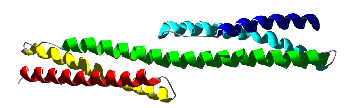
- Intrinsically disordered proteins (IDPs): A significant proportion of proteins have large disordered segments. These proteins are often involved in important important signalling pathways. IDPs fold upon binding to a target. We are developing the tools used to study globular protein folding to investigate the mechanisms of folding of IDPs.
Selected Publications
Borgia, M. B., Nickson, A.A., Clarke J. & Hounslow, M.J. (2013) A mechanistic model for amorphous protein aggregation of immunoglobulin-like domains. J. Am. Chem. Soc., in press DOI: 10.1021/ja308852b
Rogers, J.M. Steward, A. & Clarke, J. Folding and binding of an intrinsically disordered protein: fast, but not ‘diffusion-limited’. J. Am. Chem. Soc., 135, 1415−1422 DOI: 10.1021/ja309527h
Nickson, A. A., Wensley, B.G. & Clarke, J. Take home lessons from studies of related proteins. Curr. Opin. Struct. Biol. 23, 66-74.
Wensley, B.G., Kwa, L.G., Shammas, S.L., Rogers, J.M., Browning, S., Yang, Z. & Clarke, J. (2012) Separating the effects of internal friction and transition state energy to explain the slow, frustrated folding of spectrin domains. Proc. Natl. Acad. Sci. USA 109, 17795-17799.
Borgia, M.B., Borgia, A., Best, R.B., Steward, A., Nettels, D., Wunderlich, B., Schuler, B. & Clarke, J. (2011) Single-molecule fluorescence reveals sequence-specific misfolding in multidomain proteins. Nature 474, 662-665.
Wensley, B.G., Batey, S., Bone, F.A.C., Chan, Z.M., Tumelty, N.R., Steward, A., Kwa, L.G., Borgia, A. & Clarke, J. (2010) Experimental evidence for a frustrated energy landscape in a 3-helix bundle protein family. Nature 463, 685-689.
Publications
- ‹ previous
- Page 11
