
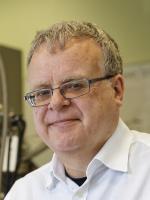
Professor of Physical & Computational Surface Chemistry
My research is centred upon the physics and chemistry of solid surfaces, explored predominantly through first-principles computational techniques (often in conjunction with ultra-high vacuum single-crystal experiments performed by colleagues and collaborators).
Past and present topics of particular interest include:
- surface structure and symmetry, with a focus on chirality at multiple length-scales;
- reaction dynamics of highly-oxidising species on semiconducting surfaces;
- electronic structure of half-metal surfaces, including states with non-trivial topology;
- non-trivial topology in bulk and surface phonon band structures;
- hydrogen and halogen bonding in adsorbed overlayers on graphite and gold;
- heterogeneous catalysis (ammonia synthesis, hydrocarbon combustion and synthesis, water gas shift, selective reduction).
In addition to my primary research, I am the author of two books - Chirality at Solid Surfaces (Wiley, 2018) and Foundations of Surface Science (Oxford University Press, 2023). I lecture undergraduate courses on the Electronic Structure and Properties of Solids; Surfaces and Interfaces; and the Electronic Structure of Solid Surfaces.
Follow me as jnknssj.bsky.social on Bluesky.
Professor Jenkins discusses his research
Publications
Proline-Derived Structural Phases on Cu{311}
Topics in Catalysis
(2015)
58
591
(doi: 10.1007/s11244-015-0400-2)
Spontaneous local symmetry breaking: A conformational study of glycine on Cu{311}
The Journal of Physical Chemistry C
(2015)
119
13041
(doi: 10.1021/acs.jpcc.5b02349)
Epitaxial growth of few-layer MoS2(0001) on FeS2{100}
Chem Commun (Camb)
(2015)
51
537
(doi: 10.1039/c4cc06628f)
Self-Organized Overlayers Formed by Alanine on Cu{311} Surfaces
The Journal of Physical Chemistry C
(2014)
118
18589
(doi: 10.1021/jp505636v)
Infrared spectroscopy of ammonia on iron: Thermal stability and the influence of potassium
The Journal of Physical Chemistry C
(2014)
118
12184
(doi: 10.1021/jp409718x)
Co-adsorption of water and glycine on Cu{110}
Physical chemistry chemical physics : PCCP
(2014)
16
6101
(doi: 10.1039/c3cp55094j)
On the role of molecular chirality in amino acid self-organisation on Cu{311}
Surface Science
(2014)
629
81
(doi: 10.1016/j.susc.2014.03.025)
Supramolecular self-assembled network formation containing N⋯Br halogen bonds in physisorbed overlayers
Physical chemistry chemical physics : PCCP
(2014)
16
19608
(doi: 10.1039/c4cp03379e)
Dynamics in surface chemistry
ABSTRACTS OF PAPERS OF THE AMERICAN CHEMICAL SOCIETY
(2014)
248
How physisorption guides chemisorption: Studied a-molecule-at-a-time by STM
ABSTRACTS OF PAPERS OF THE AMERICAN CHEMICAL SOCIETY
(2014)
247
- ‹ previous
- Page 5
