

Department of Chemistry

portrait of Professor Clare Grey FRS

Professor Clare Grey FRS

Pembroke College

Groups: Grey group website

Telephone: 01223 336509

E-mail: cpg27@cam.ac.uk

Room M21

Materials Chemistry: Structure and Function

We use a wide range of techniques, including solid state NMR and diffraction, to investigate local structure and the role that this plays in controlling the physical properties of technologically important, but disordered materials.

Rechargeable Lithium-Ion Batteries (LIBs): New batteries are required for transport applications and for storage and load-leveling on the electrical grid. These batteries should be capable of being charged and discharged faster, and should store much more power, than the batteries currently available. This requires the development of new electrode chemistries and an understanding of how these systems function. To this end, we probe the mechanisms for lithium insertion and extraction by using 6Li/7Li NMR and investigate the effect of local structure and electronic properties on LIB battery performance. Two types of electrode materials are investigated, those that operate via intercalation reactions, where the structure remains largely intact upon Li insertion, and those that react via conversion reactions where the structures transform completely upon reaction with Li. In the latter reactions, our studies focus on identifying the nano-sized (or amorphous) phases that form on Li reaction, how they are formed and how to improve the reversibilities of these reactions. Studies of intercalation compounds include the effect of cation doping and ordering on the mechanisms by which these materials react.
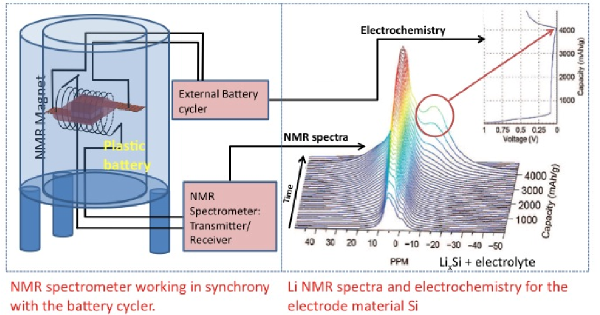
In-situ NMR Studies of LIBs: We have developed NMR methodology to monitor structural changes that occur during the operation of a battery. These in-situ NMR studies allow us to, for example, capture metastable phases, follow reactions between the electrolyte and the electrode materials and to investigate the effect of rapid charging and cycling of the battery.

Solid-State Electrolytes for Fuel Cell Membranes: We use NMR to study investigate mechanisms for ionic conduction. By identifying individual crystallographic or interstitial sites in often highly disordered materials, we can determine which sites are responsible for ionic conduction, where the vacancies or interstitial ions are located, and obtain a much deeper understanding of how these materials function as ionic conductors. Current studies focus on perovskite materials, which can act as both oxygen and proton (when hydrated) conductors.

Select Recent Publications

In situ NMR Observation of the Formation of Metallic Lithium Microstructures in Lithium Batteries, R. Bhattacharyya, B. Key, H. Chen, A.S. Best, A.F. Hollenkamp, and C.P. Grey, Nature Materials, 9, 504-510 (2010)

A study of the lithium conversion mechanism of iron fluoride in a Li ion battery, by using solid state NMR, XRD and PDF analysis studies, N. Yamakawa, M. Jiang, B. Key and C. P. Grey, J. Am. Chem. Soc., 131, 10525-10536 (2009)

Real-time NMR Investigations of Structural Changes in Silicon Electrodes for Lithium-ion Batteries, B. Key, R. Bhattacharyya, M. Morcrette, V. Seznéc, J.-M. Tarascon and C. P. Grey, J. Am. Chem. Soc., 131, 9239-9249 (2009)

Cation ordering in Li[NixMnxCo(1-2x)]O2-Layered Cathode Materials: A Nuclear Magnetic Resonance (NMR), Pair Distribution Function, X-ray Absorption Spectroscopy, and Electrochemical Study, D. Zeng, J. Cabana, J. Breger, W.-S. Yoon, and C. P. Grey, Chem. Mater.,19, 6277-6289 (2007)

Probing oxygen motion in disordered anionic conductors with 17O and 51V MAS NMR spectroscopy, N. Kim and C.P. Grey, Science, 297, 1317-1320, (2002)


Publications

Solid-state Nb-93, F-19, and Cd-113 nuclear magnetic resonance study of niobium oxyfluorides: Characterization of local distortions and oxygen/fluorine ordering
LS Du, RW Schurko, N Kim, CP Grey - J PHYS CHEM A (2002) 106, {7876-7886}
(DOI: 10.1021/jp020457q)
Probing oxygen motion in disordered anionic conductors with 17O and 51V MAS NMR spectroscopy.
N Kim, CP Grey - Science (2002) 297, 1317
(DOI: 10.1126/science.1074130)
O-17 NMR studies of oxide-ion mobility and local order.
CP Grey, N Kim - ABSTRACTS OF PAPERS OF THE AMERICAN CHEMICAL SOCIETY (2002) 224, U680
Nuclear magnetic resonance studies of lithium-ion battery materials
CP Grey, SG Greenbaum - MRS BULL (2002) 27, 613
(DOI: 10.1557/mrs2002.197)
Crystal structure changes of LiMn0.5Ni0.5O2 cathode materials during charge and discharge studied by synchrotron based in situ XRD
XQ Yang, J McBreen, WS Yoon, CP Grey - ELECTROCHEMISTRY COMMUNICATIONS (2002) 4, {649-654}
(DOI: 10.1016/S1388-2481(02)00406-X)
Probing Cs+ cation accessibility with O-2 and Cs-133 MAS NMR spectroscopy
HM Liu, CP Grey - MICROPOR MESOPOR MAT (2002) 53, 109
(DOI: 10.1016/S1387-1811(02)00330-X)
Li-6 MAS NMR studies of the local structure and electrochemical properties of Cr-doped lithium manganese and lithium cobalt oxide cathode materials for lithium-ion batteries
CJ Pan, YJ Lee, B Ammundsen, CP Grey - CHEMISTRY OF MATERIALS (2002) 14, 2289
(DOI: 10.1021/cm011623u)
Determining the lithium local environments in the lithium manganates LiZn0.5Mn1.5O4 and Li2MnO3 by analysis of the Li-6 MAS NMR spinning sideband manifolds
YJ Lee, CP Grey - J PHYS CHEM B (2002) 106, {3576-3582}
(DOI: 10.1021/jp013224s)
Li-6 magic angle spinning nuclear magnetic resonance study of the cathode materials Li1+alpha Mn2-alpha O4-delta - The effect of local structure on the electrochemical properties
YJ Lee, CP Grey - JOURNAL OF THE ELECTROCHEMICAL SOCIETY (2002) 149, {A103-A114}
(DOI: 10.1149/1.1429225)
Magnetism and structural chemistry of the n=1 Ruddlesden-Popper phases La4LiMnO8 and La3SrLiMnO8
JC Burley, PD Battle, DJ Gallon, J Sloan, CP Grey, MJ Rosseinsky - J Am Chem Soc (2002) 124, {620-628}
(DOI: 10.1021/ja012023z)


General


Research Interests


Teaching


Personal


Funding