
University Chemical Laboratory,
Lensfield Road,
Cambridge, CB2 1EW
01223 336300 General Enquiries
01223 336362 FAX
01223 762031 Admissions Office
admissions@ch.cam.ac.uk
Chemistry is the most central of all the sciences. Much of our understanding of the material world is based on the areas of Chemistry which are conventionally called Inorganic, Organic, Physical or Theoretical; but Chemistry is also central to other disciplines such as Biochemistry, Biotechnology, Materials Science, Medicine, Mineralogy, Molecular Biology, Pharmacology and Physics. This breadth is reflected in our research and in this booklet.
Following this Introduction, you will find a brief summary of the major research interests of the Department, a list of all the academic staff, and a one-page entry for each potential PhD supervisor. This booklet and further information about all the Department's research and teaching activities are also available elsewhere on the Department's website.
The Cambridge Chemistry Department consists of a large number of strong individual groups covering an extraordinary spectrum of science, centred on Chemistry, and ranging from Molecular Biology to Geophysics. The Department consists of nearly 60 academic staff, 130 support staff, 280 postgraduate students and 200 postdoctoral research workers who are supported from central funds or by grants from Research Councils, the European Union, industry, charities or other sources. Many of the academic staff, have been awarded medals or prizes, and we have 6 Fellows of the Royal Society active in research. Our strength is recognised by the award of 40% of Research judged 4* (Quality that is world-leading in terms of originality, significance and rigour) and a further 40% judged 3* (Quality that is internationally excellent in terms of originality, significance and rigour but which nonetheless falls short of the highest standards of excellence) in the 2008 Research Assessment Exercise. The key features of our present success and future strategy are:
The Department has a wide range of state-of-the-art instrumentation, much of which is described in the following pages. The Department has a long history of success in attracting research funds from Research Councils and industry for updating and improving its equipment base. Recent major acquisitions include 700 and 600 MHz solution state and 400 MHz solid state NMR spectrometers, Q-TOF and FTICR mass spectrometers, single crystal X-ray diffractometers, sub-Angstrom resolution electron microscopes, scanning microscopes and a state-of-the-art Centre for Biological Chemistry.
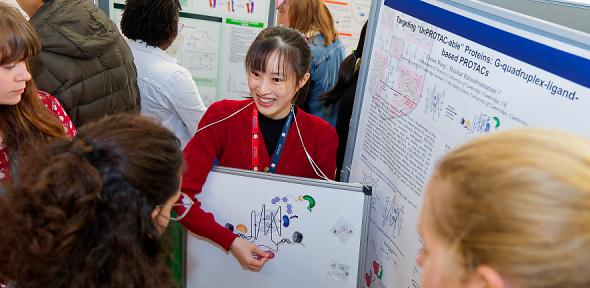
Research students become well versed in project-specific skills, general scientific awareness, and transferable skills such as written and oral communication and IT. All research students are required to give presentations of their research to members of the Department. The most common forum for this is in one of the regular colloquium days sponsored by companies such as BP, Pfizer and GlaxoSmithKline. These form part of the research seminar/lecture series which are run by the Department and amount to over 150 talks per annum in all branches of chemistry. Additionally most research groups have their own weekly meetings and many research workers regularly attend lectures in other departments in the University.
The Department has a number of endowed Visiting Professorships and Lectureships, which enables us to invite world-class scientists from all over the world to come to Cambridge to give lectures and in many cases stay for an extended length of time to interact with research groups. These include the Todd and Linnett Visiting Professorships in organic and physical chemistry respectively, the Lewis Lectureship in inorganic chemistry, the Merck lectureship in organic chemistry and the Melville Lectureship in polymer chemistry.
A central enquiry point is the admissions office (tel: 01223 762031; e-mail: admissions@ch.cam.ac.uk), which administers graduate applications within the Department. The admissions office can provide an information pack, which includes application forms for admission to the University. All of the Department's members of staff will be pleased to answer queries about their research interests. You can write, telephone or e-mail; individual telephone numbers and e-mail addresses are given on each staff member's page in this booklet.
The Department offers only research degrees at postgraduate level. There is a choice between a one-year degree leading to the MPhil, and a three-year degree leading to the PhD. PhDs are available part-time; further information is available from the Admissions Office. Formal application for admission must be made to the Board of Graduate Studies, but prospective applicants are encouraged to visit the Department and discuss possible research projects with individual members of staff. Applicants will need to be accepted both by the Department and by a College of the University, and they must have secured funding for their course before they can be registered as graduate students. Further details about the admissions procedure can be found in the Graduate Studies Prospectus, available on http://www.admin.cam.ac.uk/univ/gsprospectus/ or from the Board of Graduate Studies, 4 Mill Lane, Cambridge CB2 1RS (tel: 01223 338394). The Chemistry Department preliminary application form, for those who are able to come to Cambridge for an interview, can be found via our web site at http://www-leeper.ch.cam.ac.uk/gpapp/webapplic.html
Research students who wish to study for a PhD and obtain financial support for three years are registered in their first year for the Certificate of Postgraduate Study. During this first year, they join a research group and begin a research project, and also attend lecture courses and seminars appropriate to their research topic. At the end of the first year, they write a dissertation on their research and have an oral examination which covers their research and the lecture and seminar programmes. If the dissertation and oral examination are satisfactory, registration for the PhD degree is approved and back-dated to the student's original starting date.
Research students who wish to study for a MPhil join a research group and carry out a research project, and attend lecture courses and seminars appropriate to their research topic. They write a dissertation on their research and have an oral examination.
Chemistry sits at the centre of science. More and more chemistry is being carried out in interdisciplinary groups, with chemists interacting with other scientists such as physicists, biologists, materials scientists. This means there is a lot of overlap between the subjects, and drawing clear boundaries between them is virtually impossible. This is reflected in the way Research in Chemistry has been reorganised into Research Interest Groups where many Academic staff are members of more that one RIG.
For more information on research in Chemistry the RIG structure please click here.