

Groups: Spring group website
Telephone: 01223 336498
E-mail: spring@ch.cam.ac.uk
Our research interests originate from a desire to understand and exploit biological systems using organic synthesis primarily. Listed below are areas of research that we are exploring; for more detailed information visit the Spring Group web pages.
• Diversity-Oriented Synthesis
• Synthetic Methodology: Medium Ring Synthesis and Natural Product Synthesis
• Quorum Sensing
• New Antibiotic Discovery
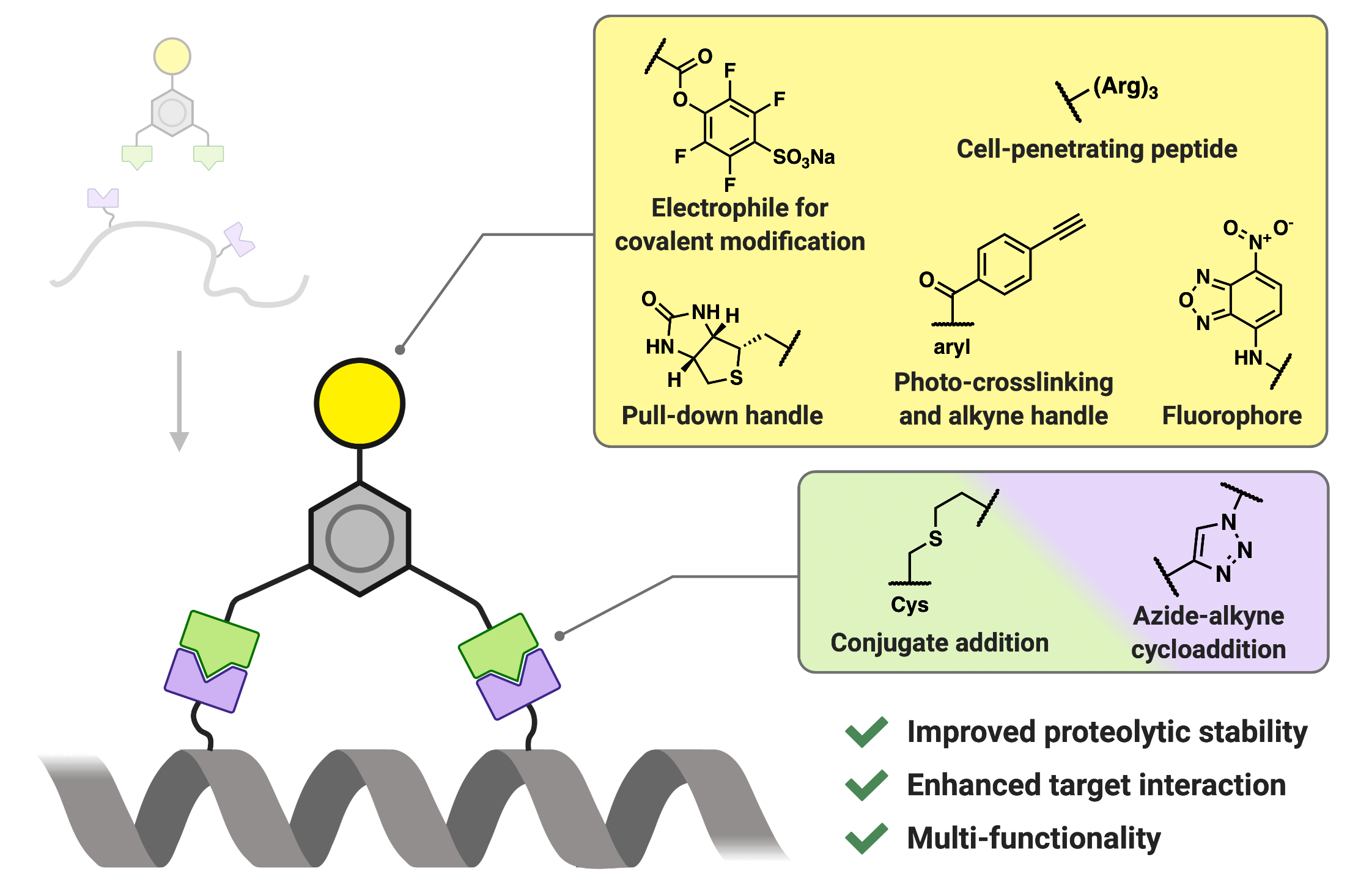
• Modulation of Protein-Protein Interactions
• Molecular Therapeutics: Chemistry-Driven Drug Discovery
We collaborate with many chemical companies and academic groups around the world. The scientific education of group members in organic synthesis is given a high priority; however, they are encouraged also to learn and perform new techniques relating to their projects with our industrial and academic collaborators. Every effort is made so that group members achieve their career ambitions, usually jobs in academia or the chemical industries.
For our most recent publications please visit the Spring Group publication page.
Diversity-Oriented Synthesis of Macrocyclic Peptidomimetics. Proc. Natl. Acad. Sci. USA 2011, 108, 6793-6798.
Better leads come from diversity. Nature 2011, 470, 43.
Novel and Efficient Copper-Catalysed Synthesis of Nitrogen-Linked Medium-Ring Biaryls. Chem. Eur. J. 2011, 17, 2981-2986.
Chemical Genetics. Chem. Soc. Rev. 2011, 40, 4332-4345.
Diversity-oriented synthesis as a tool for the discovery of novel biologically functional small molecules. Nature Commun. 2010, 1, 80.
Zn2+-Triggered Amide Tautomerization Produces a Highly Zn2+-Selective, Cell-Permeable and Ratiometric Fluorescent Sensor. JACS 2010, 132, 601-610.
Diversity-oriented synthesis of bicyclic and tricyclic alkaloids. Chem. Commun. 2010, 46, 776-778.
The molecular basis of the host response to lipopolysaccharide. Nature Rev. Microbio. 2010, 8, 8-14.
3D small-molecule microarrays. Chem. Commun. 2009, 7107-7109.
Mastering the Chemical Language of Bacteria. Chem. Biol. 2009, 16, 913-914.
The discovery of antibacterial agents using diversity oriented synthesis. Chem. Commun. 2009, 2446-2462.
Synthesis of Unprecedented Scaffold Diversity. Angew. Chem. Int. Ed. 2009, 48, 1194-1196.
Towards quorum-quenching catalytic antibodies. Chem. Commun. 2009, 538-540.
Total Synthesis of Sanguiin H-5. Org. Lett. 2008, 10, 2593-2596.
Anti-MRSA Agent Discovery Using Diversity-Oriented Synthesis. Angew. Chem. Int. Ed. 2008, 47, 2808-2812.
If you are looking for the teaching material from my lecture courses, then please go to the CamTools website.
We are extremely fortunate, and grateful, that this research is funded by research councils (A*Star, BBSRC, DAAD, EPSRC, ERC, EU, MRC), charities (CRUK, Cambridge Trusts, Frances and Augustus Newman Foundation, Isaac Newton Trust, Wellcome Trust) and industry (AZ, Bayer Schering, GSK, Lilly, Pfizer, Syngenta, UCB).
For more detailed information please visit here.